What I've Read
Books I've read since around 2019 — mostly nonfiction, mostly borrowed from the library. A green accent marks books that were particularly memorable.
August 2026
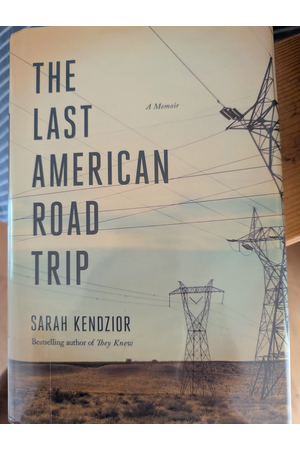
Quit this book before I even got to page 50. I had picked up this book off the nonfiction shelves in the front at Tysons Library because it's about road trips with kids; I used to love road trips with kids and wanted to hear about someone else's road trips with kids in parts of America that were out of our east-coast range. Unfortunately, this book is only partially about road trips with kids and mostly a jeremiad about how everything she doesn't agree with is destroying America. What kind of a book is that? I wanted a road trip!
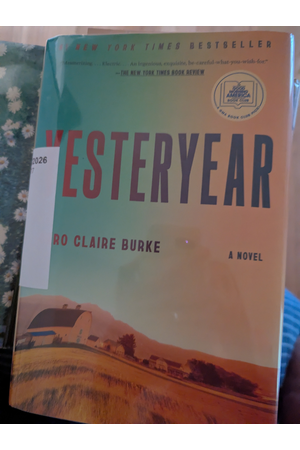
Fiction. This book had a lot of buzz, and I waited several months in the hold queue for it. Its premise had a lot of potential: a social media influencer "tradwife" wakes up and finds herself on a homestead in 1855. Sounded like an interesting enough idea to get in the hold queue. Although this book reads very fast, and I was very curious about how it would resolve the various storylines, I was disappointed by the execution. With a premise like that, I was prepared to accept a bunch of plot holes, but this book went way past that threshold. It also had (even) more anger than I had been expecting. So, overall, not recommended, even though I'm not sorry I read it due to the small time investment.
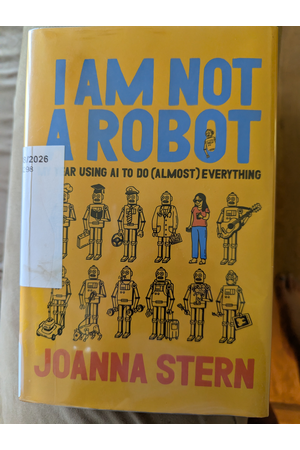
The premise here is what the title says. Stern is a tech journalist with the WSJ (though - at the advice of ChatGPT - she leaves that job to do her own thing) and mother of two boys who adopts as much AI and robot tech as she can find in her personal and professional life for the entirety of 2025. As someone who is both voluntarily and involuntarily bathed in AI due to my profession, I found the book a bit shallow. It didn't really tell me anything I didn't already know about capabilities and limitations. (My first ride in a Waymo was 100% wow, 0% fear, but I guess normal people might have a different reaction. My first robot massage - which, by the way, is a different product than a massage - also weirded me out a bit less than I suppose it would normal people. I have had useful conversations with AI when I know I need help seeing a situation more clearly than I am, and it doesn't surprise me that its bag-of-statistical output would help with that.) Pretty sure I was not the target audience, and had I been the target audience, it might have been more interesting. One insight that I definitely think Stern could have done more with is that while AI-generated music was near intolerable, AI-generated videos were watchable. While video is higher-bandwidth than music in a very literal sense, it does possibly say something about the relative depths of those two forms of communication.
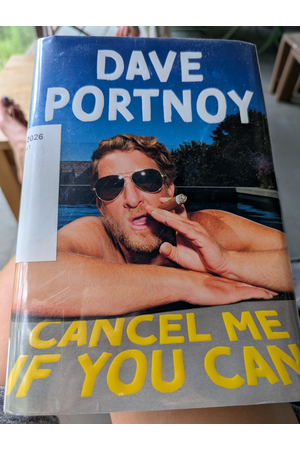
I am neither into sports, nor am I very online, either of which is a reason to have heard of Dave Portnoy or Barstool Sports. I had not. But I guess a lot of people have. The reason I read this book was that I had read an excerpt of its first chapter and was intrigued, not because of all of the controvery swirling around this guy (that wasn't in the excerpt, though I suppose it's strongly implied by the book's title) but because it sounded like it would be a fascinating and spin-free account of building what became a wildly successful media business. Which it was! Portnoy, about whom I know nothing beyond what he writes here, reads like an unreliable narrator; he's spiteful and vindictive, and he would say these things about himself. The most interesting parts of his book for me were where he talks about Barstool's various employees. Whether he has respect for the employee he's talking about or not - and he usually does not - he definitely looks down on them as entitled consumers of what he had worked so hard to build with so much less skin in the game. Interesting because I bet that's common and just not talked about.
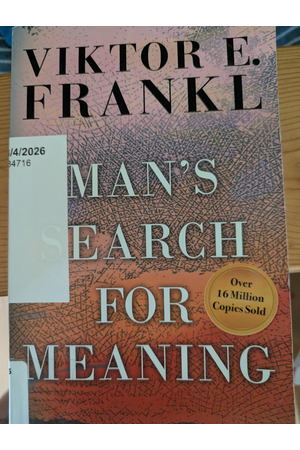
I'm not exactly sure what to say about this book. It is extremely famous. It's a difficult (but fast) read given the subject matter of its first half, which is Frankl's recounting of his time in a concentration camp during the Holocaust. The second half is a discussion of "logotherapy" (logos = meaning) about his application of what he learned about the capacity of the human spirit to his professional work. Frankl says that you can get meaning from one of three sources: What you do or create in the world; from loving someone else; or from meaningful suffering. Obviously, Frankl himself survived on meaning against very long odds. I'm glad to have read this book, and I think it's going to take me a while to give it the kind of big think that its content demands.
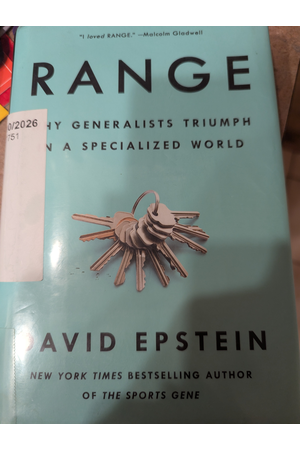
The author is an ETHS alum (!); I don't know him, but I think his sister was in my freshman advisory class. People who read his more well-known book, "The Sports Gene," told me that Epstein is great at finding interesting and far-flung examples to illustrate his points. He is! The thesis of this book is right there in the title. In three decades of being a software engineer (and being around many other software engineers), what he's saying lines up strongly with my experience. The most meaningful accomplishment of my own career, for example, which had to do with mechanisms for securing a cloud environment, mostly came out of experiences I had that were off the paved path for someone like me. The most interesting chapter to me was one about how a bumpier and higher-friction learning path leads to higher-quality learning and better retention. I suppose that's something to keep in mind as one has a hard time ramping up on something. (And raises some obvious questions of the smoothed-out learning paths with AI, even when you consume AI intelligently as a learning aide.) The criticism I have of this book is that it's quite one-sided. He doesn't entertain the possibility that the generalists whose stories he tells might be outliers - it's quite possible that creative or otherwise big-brained people are more likely to appear in the world as generalists than as "experts" (that would not surprise me). That would flip the causal arrow here. On the other hand - This book was published in 2019. In a world with capable and ubiquitous AI, it's also possible that we should cultivate the range (generalism) that comes from more "wicked" learning environments more deliberately, as it is exactly the kind of specialization that's trained in "kind" learning environments that AI covers okay. (A "kind" learning environment is one like playing chess or programming; there is direct and immediate training feedback. A "wicked" learning environment is one that offers no such clear training, such as dealing with people.) Or just yet more evidence that hobbies and avocations are very, very good.
July 2026
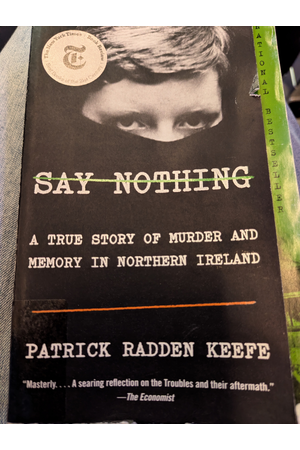
This book is about the Troubles in Northern Ireland in the 70s and 80s and the decades that followed. It is excellently written, and you can feel like you're reading an exciting novel with a complex and well-constructed plot ... except the book is very much not fiction. The first part of the book was a troubling read, as it was about acts of terrorism. The end of the book was far more interesting; it was about a project that an Irish journalist ran, in semi-cooperation with Boston College, to collect oral histories from these perpetrators, as nobody was going to straightforwardly recount the facts in the open (hence the title). Although the interviewees had been promised that their tapes would remain secret until their deaths, that didn't quite work out, and it created a complicated mess.
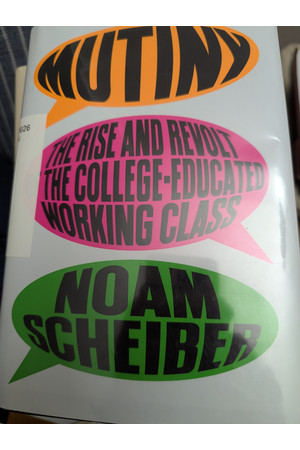
My disappointment in this book was due to my hoping it would be one thing, and it actually being a different thing. I was hoping it would go deep into the workplace-culture details of a Starbucks barista, an Apple store worker, etc. (A fantastic book that does this is called "Punching In" by Alex Frankel; or "Gig," a book from 2000 that interviews over a hundred workers, Studs Terkel style, and might be my favorite book of all time.) This book was mostly not that. Mostly, it was the story of unionization attempts at these businesses in the post-pandemic years, related from a pro-union perspective. The narrative of the book is that the phenomenon of oversupply of college-educated young adults relative to demand for those credentials meant that these jobs had a class of workers more prone to organizing than before. The author is no fan of these businesses. The heavy-handed narrative, as well as the way the writing jumped chaotically back and forth across these stories, meant I mostly did not enjoy the book. It was a fast read, so I finished it.
June 2026
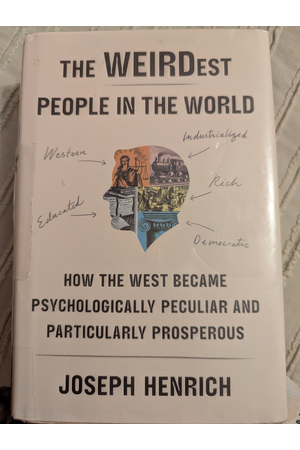
An interesting idea here, even if I don't recommend the book due to its length. I've been reading it on and off between other books I've enjoyed more, and was about to quit it numerous times. The author starts with a claim that we westerners are psychologically wired differently in some fundamental ways than other societies in the world that make us - not them - the outliers. He uses the acronym "WEIRD": Western, Educated, Industrialized, Rich, Democratic. These differences result in behaviors we would call prosocial and productive, for example an enhanced inclination to trust people outside our immediate families, adhere to impersonal rules of morality, and emphasize the individual over the group. These in turn, goes his theory, is what allows for the large-scale cooperation in societies that has enabled our scientific and technological advancement. Over 500 pages, he identifies as a root cause the Catholic Church's "Marriage and Family Program," i.e. its outlawing of cousin marriage and polygamy in the early second millennium CE. His logic is that these rules undermined kin-based institutions and made way for wider networks of trust, which in turn led to voluntary associations such as monasteries, guilds, and universities, which in turn led to wide-scale commerce, which in turn led to concepts of individuality, etc. So there; you don't need to read the whole thing! While, as a reader, I felt like this book could have been an article, I also know that, from the author's perspective, it couldn't. He's making some pretty bold claims, and so he felt the need to bring lots and lots and lots of anthropological data. And I also couldn't help but thinking about how these prosocial ideas almost definitely far pre-date the Church's MFP: Some of them are in the Torah, and while the Torah was indeed revolutionary both in its own time and today, that also means it's a fair bet that other ancient Mesopotamian cultures similarly had misgivings about, say, revenge killings or tzelem elokim (imago dei). Maybe it's possible to resolve this difference somewhat if you say that the Church was the entity who scaled these principles. One takeaway: However these principles scaled, and wherever they actually come from, how lucky we are to have been learning from them for however many millennia.
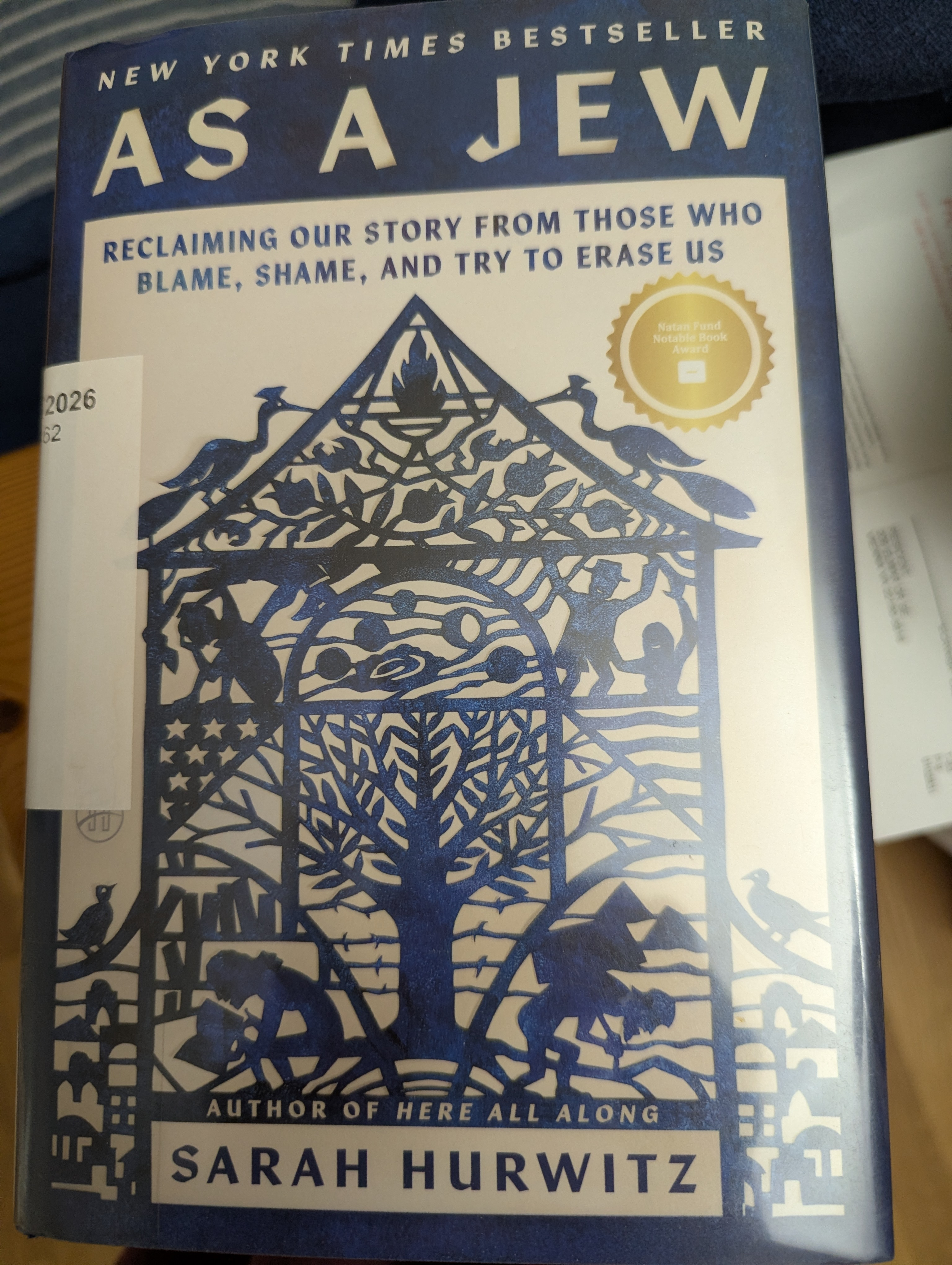
I know (and really like) the author from college. She's just such a great writer. A few years ago, I read her book "Here All Along," about her rediscovery of Judaism in her thirties. And this is not a person who does half-measures, so the depth to which she learned and shared what she learned was so interesting. This book is something of a post-October 7 followup. It's part about her, part about her learning the modern history of Israel, part a discussion of how, over millennia, Jews have taken ownership of Judaism to make it resilient against the next set of haters, and the next, and the next. She's clearly, and proudly, someone who has taken ownership of her Judaism in an especially inspiring and brilliant way. I know a lot of people who would begin a sentence with "I'm Jewish, but ..." - if that's you, then just know that this is a very fast and enjoyable read that might change your life for the better. Maybe read "Here All Along" first, but this one definitely stands on its own.
Fiction. Claude had recommended I read it, and it was a good recommendation. The story spans four generations of a Korean family, from the 1930s to the late 1908s. Over these generations, the family climbs slowly from extreme poverty in Japanese-occupied Korea to extreme wealth through owning pachinko parlors as diaspora Koreans in Japan, though always seeing themselves and being seen as foreigners. There are plenty of tragic, heavy scenes here, but in the background, people being kind and loyal to one another. The storytelling here was very good, and the chapters are short (I always appreciate that)! There was something very enjoyable about how the book moved through long spans of time. Claude had recommended this book to me, despite it being fiction, for the following reason, and I think he was mostly right: "A multigenerational novel about a Korean family in Japan across four generations, starting in the early 20th century. You loved 'Life and Fate' for its scope, its specific characters, and its backdrop of history bearing down on ordinary lives. 'Pachinko' does something similar: It's about a diaspora community that is never fully accepted in the country it has lived in for generations, and the religious and moral questions woven through it are serious. I think the Jewish parallel will not be lost on you."
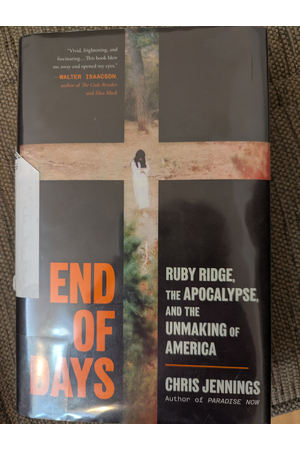
I came across a book review for this book in the New York Times; it wasn't on my Claude-curated reading list for the summer. It's a deep history of a 1992 siege operation by federal forces on Ruby Ridge in a remote part of northern Idaho, against the Weavers, a survivalist family with an extreme (and racist and antisemitic) understanding of the eschaton. I don't remember this news story registering on my then-high-schooler radar in 1992, though the related Waco story a few years ago definitely did. Might have been that I wasn't all that dialed into the news (I wasn't, though my family definitely was). At any rate, this story - involving plenty of mistakes and overreach by the feds at almost every stage - apparently inspired some of the terrible events of domestic extremism in the years directly following. The book started with a history of Christian eschatology in America; since the founding of our country, there has been a strong interest in literal interpretations of the end of the world. (I'm familiar with the book of Daniel; the Book of Revelation from the New Testament, which I've never read, is also a key source here.) It then goes into the story of the Weavers, who were from Iowa watching the farm collapse of the 80s and spinning into darker and darker ideologies, as well as their associations with other strains of end-of-days and racist extremism; they concluded the world was about to end, and they needed to be ready to survive whatever might come on a mountain in remote Idaho. The book also traces federal authorities' efforts to deal with the more dangerous elements of these movements; it was entrapping Randy Weaver into selling an undercover agent an illegally modified weapon that kicked off the spiral of events that ended in a siege and the killing of his wife and son. From here in 2026, when there is plenty of apocalyptic talk around - about everything from technology, to climate, to politics - it's curious to look back at the 1980s and wonder what could possibly have made *them*, in their seemingly much simpler time, be thinking about the end of days. It might be that in every generation, there's a strong inclination to look at the challenges of the day and think, surely, this must be it.
May 2026
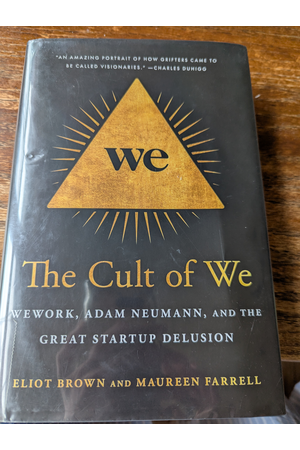
Brown and Farrell document the story of WeWork leading up to its debacle of an IPO attempt in 2019. The book was published in 2021, and a very interesting read today. WeWork as a business per se was not a scam; they rented office space, and people want that. But what was scammarific was the extent to which Neumann hyped his abstract vision (which, from what I understand here, he may well have believed himself notwithstanding how crazy it sounded)... And how willingly investors, particularly Softbank as it looked for a way to spend billions and billions of petrodollars, bought into the hype. The driver there was clearly FOMO to an extreme. The book indexes hard on Neumann and his own addiction to money. I personally found that less interesting than all of these people shoving money in his direction for a business that, while a decent idea and a good product, so clearly lacked opportunities to scale beyond linearly that would have justified anywhere near those kinds of valuations. The gullibility on display is astounding. Takeaway: FOMO is an incredibly powerful force.
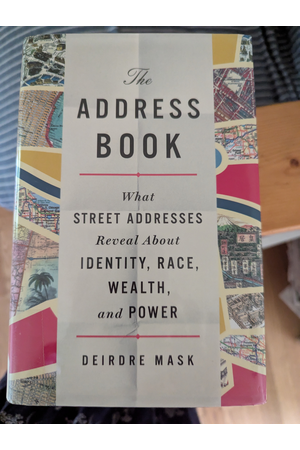
Because I've been taking notes on the books I've read for about seven years now, I was able to point Claude to all of those notes (https://books.pisomojado.org), and Claude prepared a summer reading list for me, with the requirement that it stick to books I'm likely to be able to borrow from the public library. He gave me a great list of about 25 books, and this is the first of those that I'm reading. This book, which is ostensibly about addresses, was a good recommendation. Like most people (maybe?) I've been curious about why addresses work differently in different places, for example why Chicago is so much more navigable than New York City even though New York City has numbered streets. Answer: Chicago was deliberate about its address system in the nineteenth century - every street number is a meaningful coordinate, eight blocks to the mile, with long, continuous streets, even numbers on the west and the north sides. In NYC, in contrast, prestigious addresses are for sale to the highest bidder even if a property doesn't physically correspond to those addresses, and the street numbers are in general not navigationally useful. (Numbered streets and avenues are, apparently, largely an American phenomenon. I really liked how Seattle's streets are nearly all numbered, with the only navigational complicator there being lots of natural features to get around, such as lakes and steep grades.) Mask goes back and forth throughout history and around the world on the origin of addresses: Addresses are so the government can find you. Sometimes people were assigned addresses against their will, for example in Maria Theresa's Vienna, when she needed to find conscripts for the army. Sometimes people, particularly those in distressed financial situations, have a lot of trouble because they have no address. The address facts in this book were lots of fun. The less surprising part of the book was when she talked about how much controversy arises over changes to street names; the book was published in 2020, before a lot of street names changed. My only complaint about the book was that it mostly wasn't about addresses. There's a lot of other context, history, and a bit of agenda, some of it interesting and some not. I am glad I read this book - I know a lot of things I didn't now, including what the deal is with that what3words business, which sounds like a terrible kind of availability blast radius situation - but would have preferred if it had spent more than the 25% that it did on addresses.
April 2026
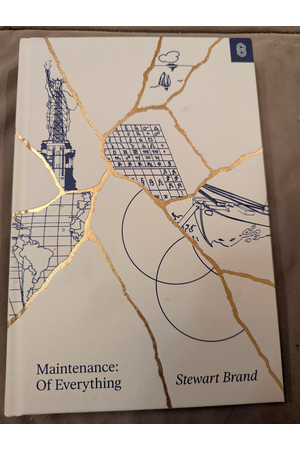
I heard the author interviewed on Econtalk, and he sounded so quirky I wanted to read his book. This is a quirky book indeed! It's ostensibly about maintenance - how so many stories of business and military success and failure come down to whether things were maintainable and whether the people responsible for those things were sufficiently attending to their maintenance. But actually the book is all about its numerous and indulgent digressions, occupying about 2/3 of the book, which would have been annoying enough to get me to quit had they not been so interesting - details on a round-the-world boat race, more than I ever thought I'd care to learn about motorcycles, military analyses of the Yom Kippur War and the ongoing war in Ukraine. Brand took these to an unexpected level of detail, and those were the best parts. So I guess I'm more interested in those than I thought. I've never dealt with boats, motorcycles, or tanks, but I have in the past operated massive and important distributed systems, and there were a few ideas in here that resonated strongly with that experience. For one, a lower-end, scrappier machine that people know how to fix and maintain, beats a perfect system; I've seen that over and over. In distributed systems, you prefer a system that fails and everyone knows what to do about it over one that "never" fails (because that doesn't actually mean never). Another, that having higher trust and autonomy, and less distance, through an organizational hierarchy (military) will be more conducive to maintenance as opposed to neglect; I've seen that too. In a very attenuated way, the stream-of-consciousness and extreme level of detail reminded me of one of my favorite books, They Called Me Mayer July a book of incredibly vivid childhood memories - including drawings - of the Pale of Settlement in the early twentieth century; that author, Mayer Kirshenblatt, was similarly obsessed with details about machines, and it was unexpectedly fascinating. See my notes on They Called Me Mayer July here: https://books.pisomojado.org/#book-they-called-me-mayer-july
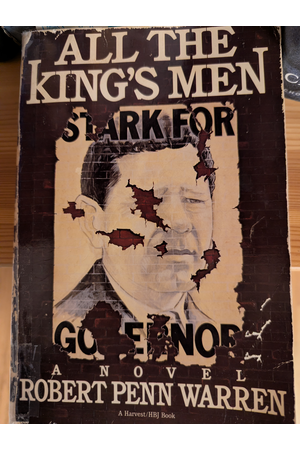
Fiction, written in 1946. I don't read a lot of fiction, because I don't usually enjoy it, but this book was fantastic. It's nominally about a government of Georgia who is said to have been roughly based on Huey Long, told from the point of view of his oppo-reseach fixer. There's a lot of plot stuff in there that I recognized as well done if you are into plot twists, but what I loved is the language and the scenery that made up the storytelling - it made the numerous digressions (the book is quite long) even more fun than the plot. The story behind the story is one about truth and its encounters with the real world. This might be in my top three fiction books of all time, alongside East of Eden and Huck Finn.
March 2026
Patel is a podcaster, and this book has a strange format that makes it a little challenging to follow. It appears to be a series of short monologues and a Q&A[ish] between Patel and a who's who of AI. There's no shortage of these people being quoted on the Internet, but it was interesting to me to hear a bit past the sound bite of how these people regard what they've built, or at least how they talk about it. The numbers are pretty cool, and there's good de-jargoning that I found useful. A perspective that many of them have that helped me understand how they see the world: They view the existence of LLMs (specifically, the ability for statistical prediction to become something we recognize a reasoning) as more of a discovery of a thing that has always existed in the world, rather than an invention. Just like electricity was always there, and humans at some point discovered how to generate and use it, and the whole world changed as a result. I am not necessarily convinced AI is like that, because I do believe there is something special about reasoning, but once you know this is their frame of reference, you can understand a bit more about why they say the things they say. This wasn't exactly journalism, so there's no reasonable expectation of seeing a contrary point of view, but I did find myself wishing it were at least somewhat presented. Regardless of what actually happens in the coming years, these conversations will be a fascinating point-in-time historical artifact.
This was recommended reading for my new job, but if I had known about it, I would have read it long ago. It explains, in layman's terms but nonetheless a satisfactory level of detail (for me, now), what exactly happens when you swipe a credit or debit card. That was something I have been curious about for a long time. There are some explanatory cartoons. It's a light, quick read.
February 2026
I started reading this book many, many years ago, in 2011. At the time I worked on Bing in a frontend-focused team and a colleague recommended it. At the time I also had small children and a job and ... Not so much with the reading books! I decided to read it again. The latest edition is 2013, so somewhat dated, though the author could talk about modern-ish cell phones. I'm glad I finally read this classic. The part I enjoyed the most was his analysis of mistakes; in the last few years at work I've focused a lot on mistake-making of various kinds. I would have learned more from this book in 2011, of course. The author seems a bit full of himself; was mostly able to read past that for the substance, but I'm kind of glad to be done "talking" to him nonetheless. Although the author couldn't have anticipated the AI we have today (though quickly alludes to the possibility that technology gets more humanlike), that angle on all this is interesting too - there will likely be whole books written on design for agents on the things we want agents doing (right now it amounts to "good and complete documentation and well-defined tools" but probably involves so much more). As well as whole books on the design of the agents themselves (right now amounts to a bunch of just-so prompting but probably involves so much more). Neither of these seems yet known.
December 2025
Bessis is a mathematician, and this book is his attempt to describe what happens in the brain of someone doing math. As a math-adjacent person, I found it a fascinating read; probably the best book I've read this year. He describes the process of building mathematical intuition as an async process of creating intuitive devices in the form of visual images, a combination of curiosity and imagination that requires flexibility of intuition. (He talks a lot about imagination and dreaming in particular; I've been trying his techniques for better remembering dreams and I'll see if they work!) He says that one of the reasons so many are put off by math is that mathematical intuition doesn't fit well into human language (which matches my experience very much) and that's why actual math doesn't ever get taught. There's a lot in here about asking "stupid" questions, which is something I care a lot about, so I loved seeing it discussed in the context of math. He names but doesn't seriously entertain the notion that moments of mathematical insight might be a brush with the Divine. And he also rejects the idea that there's such a thing as "good at math" or "bad at math"; rather, he claims that, given that the real mathematical process of training your intuition is never taught, some people happen to encounter it in life and some don't. I'm not sure he's right, but that sure would be nice if it were so.
September 2025
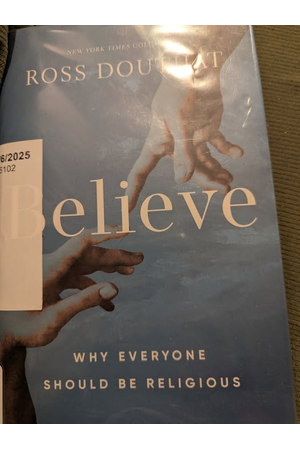
Douthat is an opinion columnist for the New York Times. He's a devout Catholic, and he wrote this book to set out his position on religious belief as a rational and intelligent conclusion for modern, thinking people. At the outset, he says that the best audience for the book are people who wish they were believers, but who've either been told or concluded that religion is mythology incompatible with our scientifically-informed world. (As opposed to people determined not to believe.) I really enjoyed seeing his thought process. I am lucky to know quite a few highly intellectually rigorous people who are deeply religious (and also highly intellectually rigorous people who hold every other possible conclusion on religion!), though most of the conversations I've had with such people have been through a Jewish lens. Some of Douthat's approaches to this topic were therefore at least somewhat familiar to me. (There are Jewish approaches to these topics, with which I’m far more familiar, that obviously weren't in this book.) But because, at least at the end, he discusses faith from a specifically Catholic perspective, some of the approaches were entirely unfamiliar, which was sometimes fascinating and sometimes bewildering, just because I lacked the background knowledge to fully get the references. The book is fairly short and extremely well written, but parts of it are not quick to read, as you'll want to think about what he's saying. For anyone who's in his target audience - as in, you think it’s not smart to believe, but you’re not opposed to the idea - I would recommend this book.
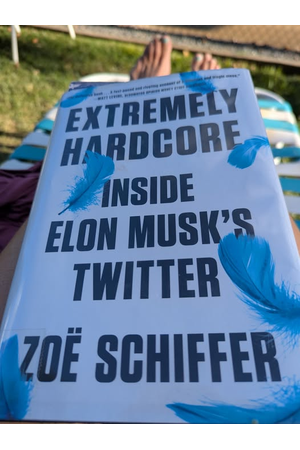
Interesting read, though I'm not sure I'd recommend it. I myself have never had an account on Twitter/X, so everything I personally know about the platform is at least secondhand... Including this book! Two things make me hesitate to recommend it. First, the author's political views are prominent (though I'll acknowledge that the twin supercharged topics of Twitter and Musk are probably near-impossible for anyone to document neutrally). Second, where the book touches on technical aspects of service operations, it was a tad off in the details, enough to irk me just a bit.
August 2025
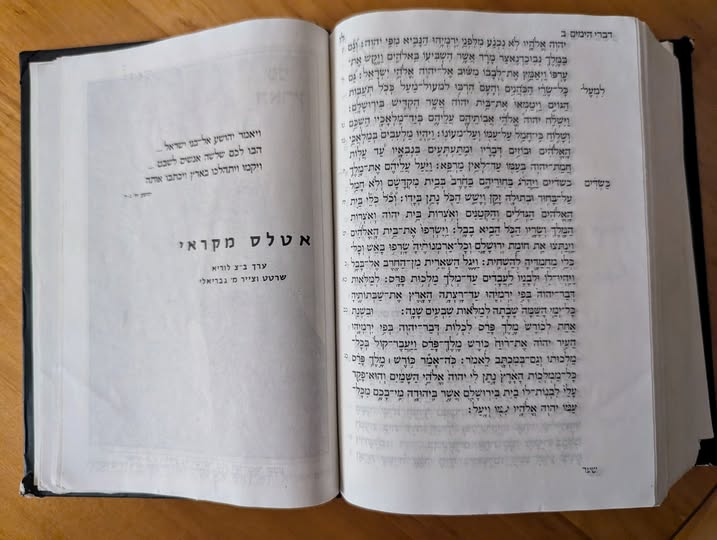
This obviously is not in the same category as other, entirely human-authored books I have read, but I feel like not including it here would be odd, as it is the largest and most important reading project I have done in my life. If I could double-underline it, I would. Here is what I said about it at the time: I am so grateful and proud to have arrived at this moment. Tonight, I finished the cycle of 929 (Tanakh B'Yachad). This was a project in which Jews around the world read the entire Tanakh (Hebrew Bible), start to finish, all 929 chapters of it, one chapter a day, five days a week. We started in February 2022. ... ויעל. (If you are more familiar with the Christian Bible: The Old Testament is roughly the same set of books as the Tanakh, with a few extra books. Interestingly, the order is completely different. The Christian Old Testament is ordered in roughly chronological order. Thus the last book is Malachi, from the Second Temple period, and it ends with a powerful prophecy on the arrival of Elijah before the “great and awesome day” - which is why, at a Passover Seder, there is a cup of wine for Elijah at the table, and later in the night, we open the door for him. But the Tanakh is not chronological and instead ends with Second Chronicles; that “ויעל” above is the final word - and they went up. It too is an incredibly powerful ending, as it refers to the decree of King Cyrus of Persia that the Jews were to return to their land and build the Second Temple.) What an incredible journey. The books of the Tanakh contain everything from the word of G-d, to the word of G-d via man, to the word of man (and one woman, I think!) to his fellow man - prose, commandments, stories, a tiny bit of humor (by the woman), prophesies, expressions of deep hope, and some of the most beautiful poetry. I've learned so much. הדרן עלך עשרים וארבעה ספרי התנך - We will return to you, 24 books of the Tanakh.Starting over tomorrow!
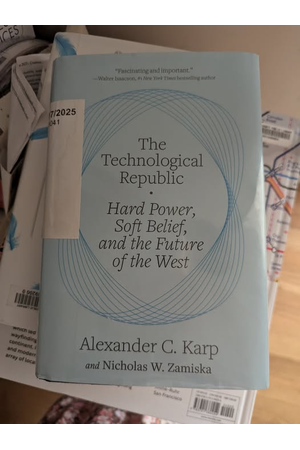
Karp is the CEO of Palantir. This book is a fast-ish read, more or less a collection of essays. His thesis is that Silicon Valley's behemoths, founded as they were by people whose worldviews were formed in what they believed to be the "end of history," have shied away from meaningful missions, instead focusing on consumer goodies and ads. He points back to WWII, when America's industrial and technological superiority was actively involved in the defense of freedom. He calls for a renewed focus on "virtue, values, and culture" in the tech industry.
July 2025
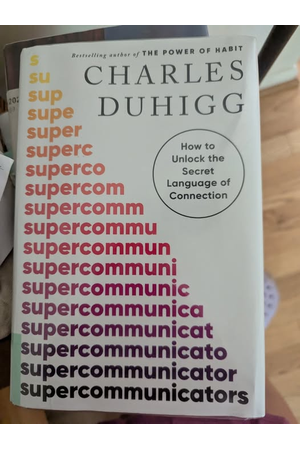
Duhigg was a guest on Econtalk shortly after this book came out, and he gave a great interview. (One could say he communicated super!) This book is a fast read. The idea is mainly that you should figure out whether the conversation you're in is to accomplish a specific goal; to share feelings; or to allow people to communicate something about an identity of theirs. Lots of management consultant-y diagrams to that end, though no Conjoined Triangles of Success, sadly. In a sense this is all kind of obvious in principle and devilishly hard in practice, as it basically amounts to the importance of listening to your counterparty, assessing what they actually need, and providing that. I do not know whether I'm doing that better as a result of having read this book. I hope so but suspect a lot of practice is needed.
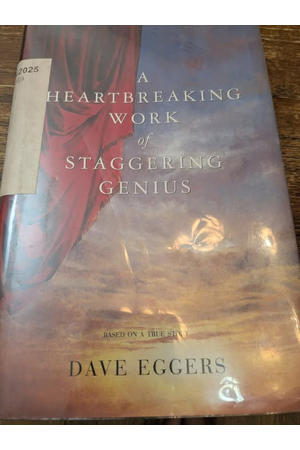
Fiction. I had read a few others of his novels in the last few years (The Circle, Hologram for a Long) and liked them. I was reading this one because Russ Roberts mentioned on Econtalk that this novel was the funniest book he had ever read. It's written in a very into-itself way, including some very over-the-top introductions and prefaces, which I skipped because they were starting to annoy me. But I turned out to like it okay. Both of the narrator's parents die within a few months of each other, and, as a 20-year-old, Dave becomes the guardian of his 11-year-old brother Toph and has to raise him. They move to California and have this life with a crazy mix of responsibility and irresponsibility, toughness and self-pity, slacking and weird success. The book is delightfully Gen-X and west-coast 90s. It also keeps using bizarre literary schticks that were very Literary, but not for me. I think that the book is at least partly autobiographical.
June 2025
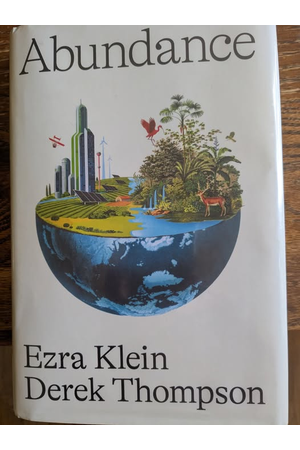
The book presents an alternative take on progressivism, proposing that we as a society build a lot more - buildings, energy, technology - and that government take a bigger role with bureaucratic bottlenecks removed. The book is written in such a way to make me guess that one or both of the authors has ambitions to run for public office someday.
The ideas here were interesting, though there were a few ideas I was expecting or hoping to see their point of view on that they didn't address. One example was AI, which was briefly mentioned specifically in the context of energy demand. My guess is they were deliberately avoiding saying something that might not age well for any number of reasons.
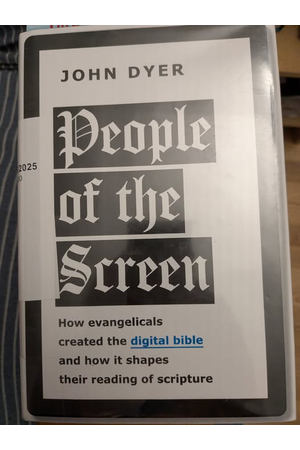
The author, a professor at the Dallas Theological Seminary, was a guest on one of my favorite, albeit infrequent, podcasts, "Belief in the Future," hosted by David Zvi Kalman. The podcast covers the interactions between religion and technology, and every episode is fantastic, with guests from many different faith perspectives. On this episode, Dyer talked about the history of digitized Scripture in the Christian world and how it affects readers' approach to studying it. An interesting insight is that readers tend to prefer the softer, more "redemption" types of passage when using a digital Bible and the harder, more "judgment" parts on paper. Kalman in the podcast episode also dropped a few interesting facts about Jewish digital sources - was one of the first 100 DNS domains bought by the public on the Internet, and Hebcal was started by some Penn students in the 90s for organizing their minyan. Sefaria, an incredibly broad collection of Jewish sources and commentary, changed how most Jews study or prepare to study any Jewish source.
Dyer was a fantastic guest and made for an interesting interview with Kalman, so I sought out his book. The book is written in an academic style and might have been assuming more context in Christian approaches to Bible study than I have. I didn't get much past the first chapter.
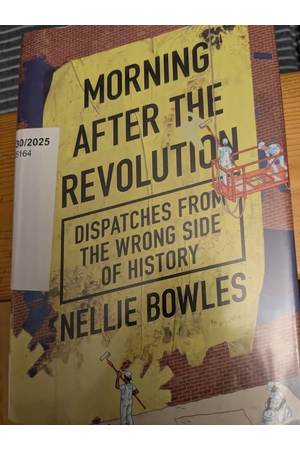
I expected to enjoy this book about the excesses of the last few years more than I did, especially since I enjoy Bowles's newsletter in the Free Press. The problem, I think, is that it was meant to get the reader angry. The outrage-o-meter was higher than (I) needed. Fast read, and Bowles is, as usual, pretty good at pointing out hypocrisies.
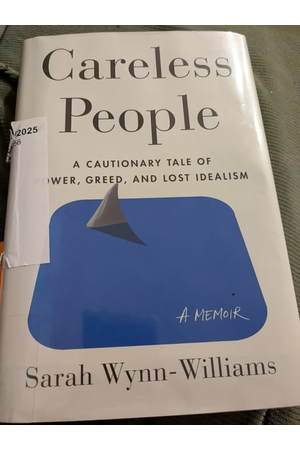
This book, written by a former director at Facebook and critical of their leadership to an extreme, was very briefly in the news, until Facebook did something to prevent the author from promoting her book. The book itself: Eh. Least it was a fast read. The thing I'm curious about is whether you're going to see this post at all. [It did show up in friends’ feeds on Facebook.]
April 2025
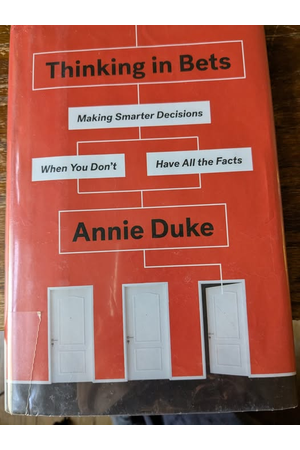
Duke is a professional poker player. She has won various championships and has leveraged that into being an expert on the process of decision-making. The book could have been an essay, but it reads fast and has a few reminders of things I already sort of know but constantly struggle to apply in practice: techniques for increasing one's ability for truth-seeking (rather than motivated) reasoning, commitment devices, "pre-mortems," and so on. Solid advice. I'm not sure I got anything new out of this book beyond a much-needed reminder. I also do not have the foggiest idea of how poker is played.
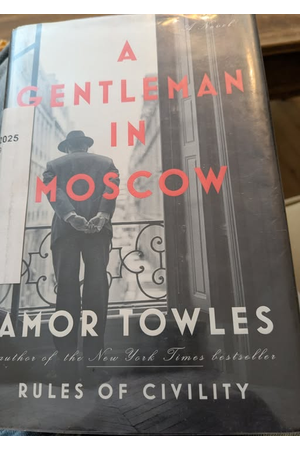
(Fiction) A Russian count gets sentenced in 1922 to house arrest for the rest of his life in a fancy hotel for some poem he wrote. The story continues for about three or four decades from there. The storytelling is highly enjoyable, even if there isn't much in the way of a plot until the last few pages. On the surface, it's a sad book for obvious reasons as the Count watches things deteriorate around him. But it's also a beautiful book about his ability to assemble a very full life - including a family - around himself using the pieces available.
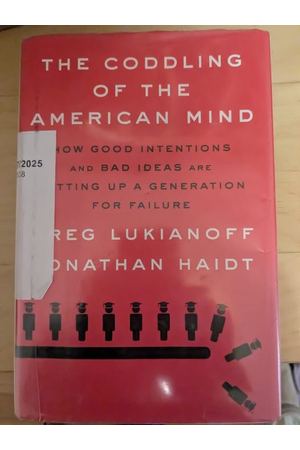
I learned about this book from Jenny Hoffman, whose thoughtfully compiled list of books she's read or audiobooked on her long runs I appreciate and use for ideas of what I should read. As the cover suggests, they dig into the phenomenon of "safetyism" that they observe among kids and young adults born since about 1995. Their argument is that it arises from three cognitive distortions: 1/ a lack of belief in the ability to withstand physical and emotional injuries and insults; 2/ a quickness to believe emotions rather than question them; 3/ an us-vs-them division of good guys vs bad guys. This book was written in 2018, and the authors at the time believed they were living in an age of especially heightened emotional thinking. I suppose they had no idea what was coming next; I'd love to hear what they'd have to say about the last seven years.
January 2025
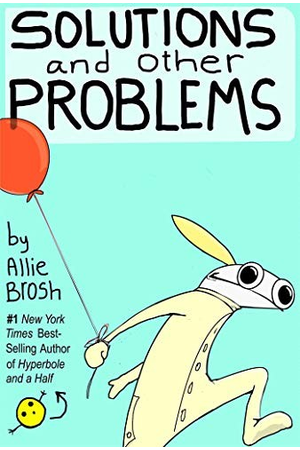
This is a graphic novel. Or something like that. It was strange and I mostly didn’t like it. EJF got it for me for Hanukkah, because 1/ actually he didn't; his friend had bought it for himself twice by accident, and this was the extra, and 2/ he said the title made him think of me.
The author is the one who originated the "Clean All the Things" meme.
December 2024
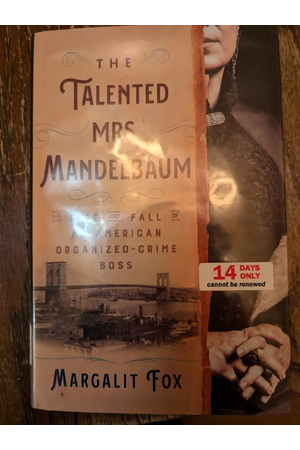
I ended up quitting this book; just plain lost interest midway through. The subject of the book ran a fencing ring for stolen goods on the Lower East Side of Manhattan in the Gilded Age, directing a bunch of thieves. Kind of got the idea early on. Okay. It's a bit too "story-told" for my tastes, but the NYT really liked it.
November 2024
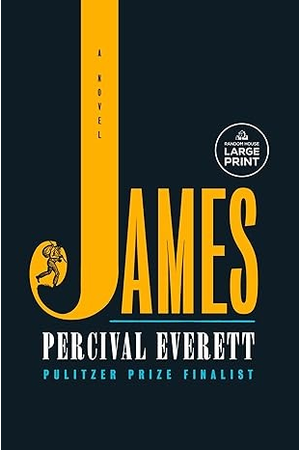
I was in the hold queue for a good long time! Not a big fiction reader, but The Adventures of Huckleberry Finn is one of my favorite books of all time, so I kind of had to read it. It's good, with one laugh-out-loud funny scene - Jim's perspective on the Duke and Dauphin con in Huck Finn. A fun read, and quick. It made me want to reread Huck Finn.
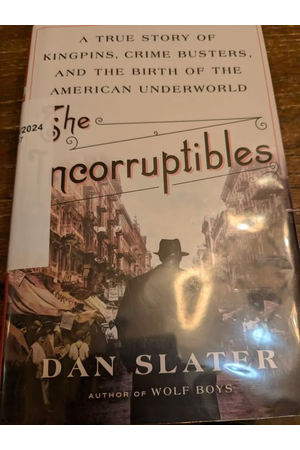
The subject of the book is the Jewish gangsters that overran New York City's Lower East Side at the beginning of the 20th century, with the support of the Tammany Hall political machine - and the Jewish vice crusaders who convinced the mayor of NYC to let them run a vice squad in the NYPD to take them down. It was this "reform" movement that morphed into Prohibition in later decades and, the book implies, today's War on Drugs. Arnold Rothstein is a major character in this book, and I'm hoping that what I learned here won't spoil the seasons of "Boardwalk Empire" that I've yet to watch. So many interesting tidbits in here, for example that The Forward (New York's Yiddish -language newspaper - which still exists, and for which my sister has contributed political cartoons in Yiddish!) actively sponsored labor-union thugs. There's a fantastic glossary in the back, with many Yiddish terms for houses of ill repute and their various associated persons, of which I knew barely half! Not that I have much use for those words.
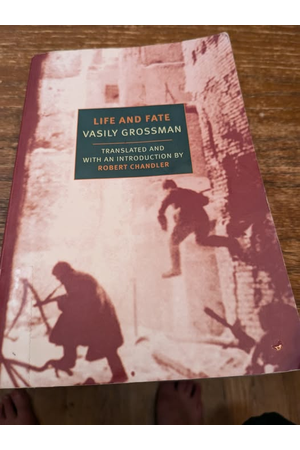
(Fiction.) I read it because Russ Roberts, the host of my favorite podcast, Econtalk, plans to do an episode in which he and Tyler Cowen discuss this book. I'm looking forward to it! Reading this book was quite an undertaking: 870 pages, and, being a Russian novel, tens of characters to keep track of. Apparently this novel was deemed too dangerous to publish in the Soviet Union when it was written (1960) and was smuggled out, page by page. It follows multiple interrelated groups of people, both military and not, during the battle of Stalingrad. The backdrop is war, with some horrifying scenes (not the kind of thing I normally seek out). Throughout, the characters go about their business with some all-too-recognizable human reactions to people in positions of power and forces of conformity. The book takes about 400 pages to establish how the characters are connected, but once it did, it was a great read. Probably one of the more memorable fiction books I've read in a while
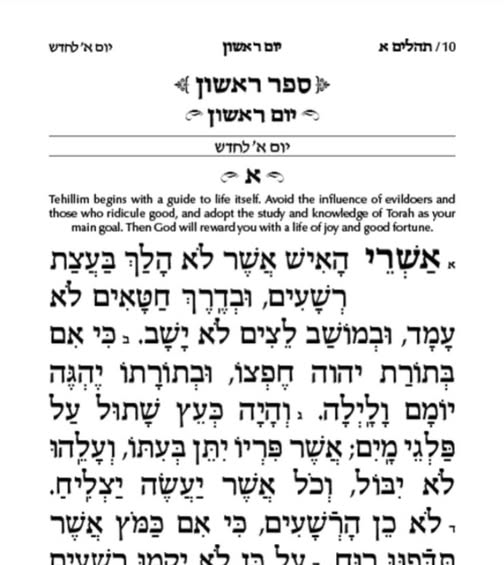
The 150 Psalms are the national poetry of the Jewish people and are referenced often in Jewish and Christian liturgy, in classical music and literature of the Western world, and even in modern culture. For the last nearly three years, I have been reading along with the 929 project. https://929.org.il is a program run by the Israeli Ministry of Education, in which people all around the world read the 929 chapters of Tanakh (Hebrew Bible) , one chapter per day, five days per week. We started in Feb 2022 and will conclude in Aug 2025. Today, the 929 project finished the longest book, with the final Psalm 150 (that's thirty weeks!). I've especially enjoyed searching for and listening to the many, many musical renditions of the Psalms composed throughout the ages- mostly in Hebrew, but also in Latin, German, and English. The companion podcast by Alex Israel that I've been using to learn them has been an invaluable study aid as well; I'm so appreciative of all the effort he puts into producing it.
How it ends: כל הנשמה תהלל קה, הללויה / All who breathe shall praise G-d, Hallelujah.
October 2024
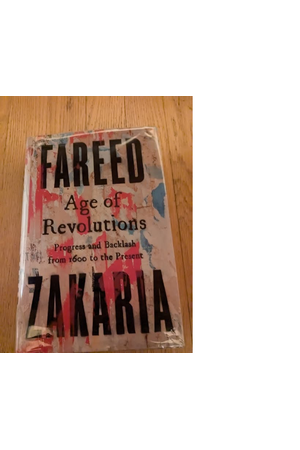
He starts with some famous revolutions in the history of Western civilization - Dutch (financial), British (industrial), and French (political; failed due to extremism). I loved learning about that era of history in high school, so it was fun to read about those again through this lens. Then he goes into our modern era, which does seem to be one in which radicalism and other kinds of revolutionary zeal may be having a moment. I kind of forced myself to read that second half. It's long and gets a bit lecture-y and, at times, there's a political slant that I think gets in the way of his making his point effectively. The basic thesis is that, like other major transformative ideas in history, the small-l liberalism that has led to the prosperity of the West is at a crossroads because of too much change, too quickly. I finished it; fine. I think I learned something.
September 2024
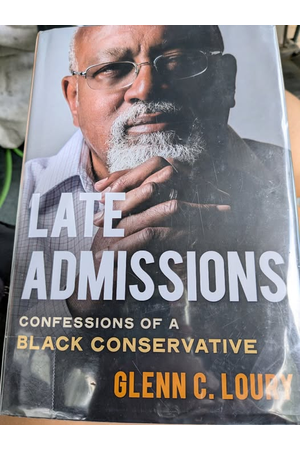
I heard the author interviewed on the Econtalk podcast earlier this year, shortly after this book came out; the interview was quite good. The book is an autobiography of Loury, an economist and political theorist who's now in his seventies, and it goes back and forth between his career/intellectual trajectory, and his personal life. Loury grew up on Chicago's South Side in the 50s/60s, fathered two children as a teenager, and, on a recommendation from a professor at the community college where he was taking classes while working at a printing press, ended up at Northwestern, where he discovered an extreme talent for math and economics. It's extraordinarily well written, and I really enjoyed reading about the evolution of his views and approach to being a "black economist" and "an economist who was black" over the course of his career. Reading about his personal life, particularly how he treated women, was another matter, and made it difficult to respect the guy, as brilliant as he obviously is. There were other things that were hard to comprehend, including going to some of Boston's rough neighborhoods to smoke crack while a professor at Harvard's Kennedy School and eventually becoming an addict, relapsing multiple times, being born again, then not. The book's not short, but it's interesting. I'm not actually sure what to think after reading it.
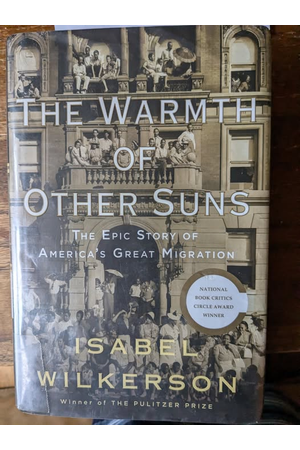
I got in the hold queue for this book at the library a few months ago; it was one of the surprisingly few nonfiction books on the New York Times' list of best 100 books from this century, at #2 overall. I can see why; this was an incredible book. Wilkerson, a journalist, took what I think was a period of over ten years (book published in 2010) to interview and follow three senior citizens - one in Chicago, one in NYC, one in LA) - who in their youth had been among the millions of black Americans migrating to big northern cities as part of the Great Migration. (She herself is the daughter of parents who migrated from South Carolina to DC during that period.) I knew about the Great Migration from US history, but these in-depth, detailed stories of three respectively very different lives provided a completely different, personal window into it. Although Wilkerson says that most of the migrants would reject the label "immigrant," as they had been Americans long before most others, you can't help but see it that way, at least somewhat. A long book (500+), but so fascinating and well-narrated that it took only two weekends to read. This was the best book of my summer reading season.
August 2024
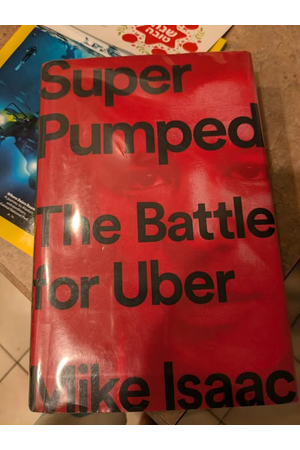
I love a good business journalism book. (Think my favorite is still the classic Barbarians at the Gate on RJR-Nabisco) I had seen the Showtime series of the same name and enjoyed it, and the book, of course, had more details and less schtick.
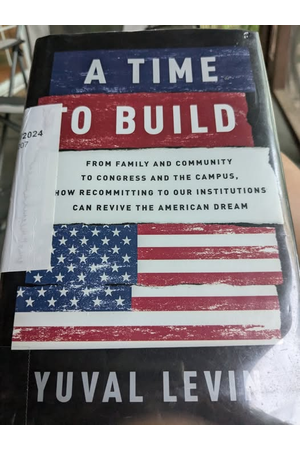
A few months ago, I heard Levin interviewed on the Econtalk podcast (). He offered a thoughtful and hopeful perspective on our current moment, focusing on how the Constitution is actually designed for the types of disagreement we're having. His tone was quite different from the panic that it's all too easy to find out there. So I wanted to read his book. The Fairfax County Public Library didn't have his latest book, but they did have this one, published in 2020. I found it thought-provoking. His thesis is that a key challenge of the moment is that our institutions have become too weak, offering less of a mechanism to mold their members and leaders according to their missions, and more a performative platform for individuals. And that this weakening has, in turn, led to less trustworthy leadership of those institutions. He focuses on politics, journalism, universities, and religious institutions in particular. His call to action - how individuals can bring back the institutional strength that they need - is to commit more fully to the roles they play: at work, at home, in various other organizations. He says we each need to ask, "Given the role I play in this institution, how should I act?" - in other words, forming oneself to the mission of one's institutions,
rather than insisting that the institution serve as a platform to elevate the individual. Interesting that this book was written before 2020; the events since then seem to me to underscore his point. Quick read, a lot to think about, and I'm glad I came across it.
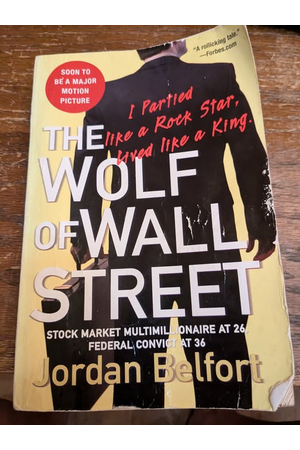
I saw the movie about ten years ago. I liked the movie all right. This book is written by Belfort himself. As I read through the book, which is not short, I started to wonder whether what he's narrating was even true. He seems non-credible. So I just kind of read it as a work of fiction, and it was entertaining enough. I'm glad to have finished it.
July 2024
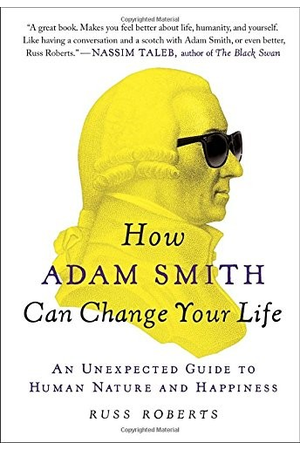
Roberts is the host of my favorite podcast, Econtalk, and he's an avid student of Adam Smith. This book is a reading of Adam Smith's "other" book, The Theory of Moral Sentiment, whose topic was more philosophy than economics. I really enjoyed reading it and found it insightful. Smith writes that humans desire to be "loved and lovely," and Roberts unpacks what that could mean to a modern person. There's a lot in this book (both Smith's original writing and Roberts's commentary on it) that reminded me of Pirkei Avot (Ethics of the Fathers), the tractate of the Mishnah that's a compilation of ethical directives and maxims. Roberts himself quotes the Talmud a few times. Overall, some insights and reminders on how to be a good person in the modern world and how to influence others to good.
June 2024
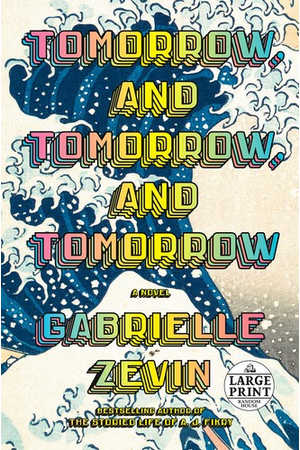
Everybody likes this book, and I'm part of everybody. The book is part about video games, part a love story. I have never cared about video games and have almost never played them. Even so, the storytelling was so good that I read the book in under a week. The one thing that grated on me is that most of the book is set in the late nineties and written by someone my age, but the language and sensibilities are anachronistic 2020s-isms such as people talking about a "safe space." That bugged me a little, but my daughter pointed out that that might be because the author is anticipating much younger readers who won't find it jarring. Thanks Karen Haberkorn for the recommendation!
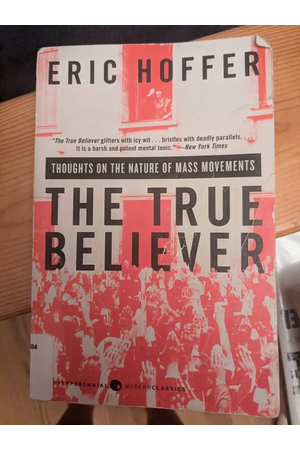
During the year, I put books on hold for pickup in the summer , and I must have done so with this book. I don't remember this one, but I'm guessing that it may have been mentioned in an op-ed or something, and I wanted to read it. It's something of a ?manifesto? (though not in the crazy sense) on the conditions under which a person can get swept up in some or other mass movement, be it positive or negative. This book was written shortly after WWII, and one interesting meta-observation is that he writes about mass movements as something that happens in other places, to other people or in other times. Of course, I'm reading this book in 2024, when things are shaped quite differently. (And I bet that's why I saw this book mentioned months ago and thought I might read it.)
The observations seem right (though what would I know), but for now, I've quit the book. I might yet finish it before it's due. It's pretty short.
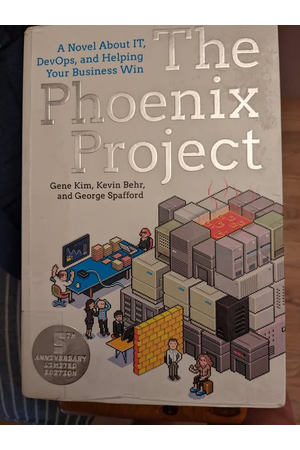
This is a novel about DevOps (!), written eleven years ago. I heard about it from a breakfast reading group at work, as in, "You've never read ...??" This book is explicitly modeled on The Goal by Eliyahu Goldratt, a management consultant-y novel (!) about the "theory of constraints." Most of us at Amazon have been told to read The Goal at some point; it's about managing bottlenecks. The Great American Novel this is not (neither is The Goal); nonetheless, it has useful insights (and plenty of outages). It's about an IT department at a non-tech company, trying to deliver a chronically late project amid constant setbacks, compliance findings, and other randomizations. It's a little dated; they do use the cloud, but mostly just to temporarily scale up. I'm glad I read it. As an added bonus, the acknowledgements include my colleague Bill Shinn, whom I got to see just this week! (Added later: Tragically, Bill passed away in late 2025. His memory lives on among all us AWS security nerds, as well as in this book!)
May 2024
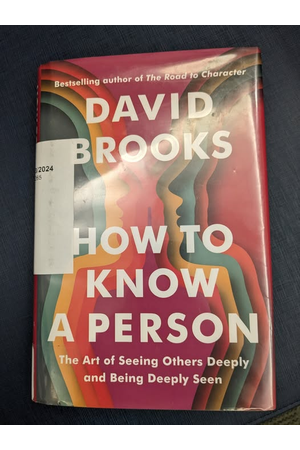
This book doesn't exactly tell you anything you don't already know: Each person you encounter is deeper than you think; most of them want to have a deeper conversation with you than they probably get to; each of them is the hero of his own story, etc. Nonetheless a good reminder of trying to get through the interpersonal parts of your day in a less transactional way.
I had it on my lap on a short plane ride a few weeks ago. (I didn't crack it open because I had some other things that needed a think during those two hours.) The gentleman sitting next to me asked me about it, because he had heard of it and had been thinking of reading it. And, unsurprisingly, we ended up in a very deep discussion about his life trajectory, which was fascinating. He had graduated from a military academy, enjoyed a distinguished career in "Washington jobs" including nuclear de-escalation with the USSR. In middle age, he tragically lost a stepson to a rare disease, after which he and his wife completely pivoted their life's work to raising funds for the study of the disease. He was en route to a medical conference to give a talk about it. While obviously no person should ever have to suffer the tragedy he did ... An inspirational person. Who probably would otherwise have just sat there sipping tea while I zorked out on the thing I was thinking about that day.
March 2024
About Sam Bankman-Fried. This was Michael Lewis in full effect. The discussion of SBF's early career, at Jane Street, and the way they thought about probabilities of everything, was my favorite part, even though it obviously wasn't the main event. Fair warning: Despite Lewis's excellent storytelling skills, if you're hoping this book will explain what the heck actually happened in FTX/Alameda, you might be disappointed. It remains beyond comprehension! (And I suspect that might hold true for all the news stories we can read about it - and likely part of the problem itself).
Lewis's strength is when he can work with his subjects' personality quirks, of which there was no shortage. Surprising that he got the level of access he did to the people involved.
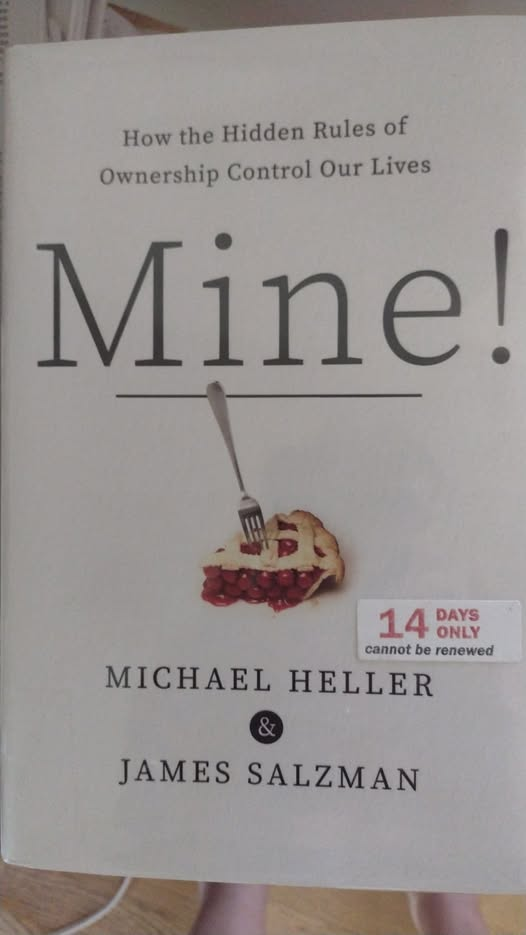
14-day no renewal, but fortunately it reads quick.
September 2023
(Fiction.) A fast read, and really fun. It won the 2023 Pulitzer Prize, which was about when I had gotten in the hold queue for it. It starts with a story about an eccentric 1920s financier that's fun to read in its own right, but then continues going more and more meta about that story, and you learn in bits and pieces about what's actually happening. What a great way to close out my 2023 summer reading season!
August 2023
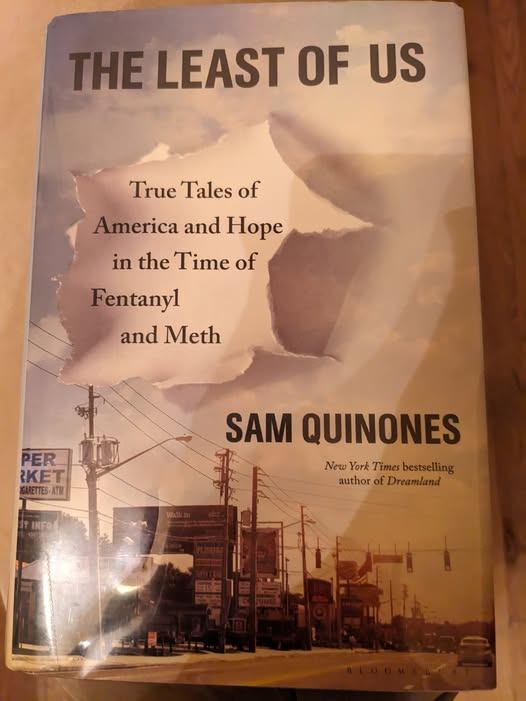
This book is a follow-up to Quinones's prior book, Dreamland, which I read earlier this summer. Dreamland had covered the oxycontin/heroin epidemic of the late 90s and early 00s, and this book continues the story into the 10s. During this time, Mexican drug operations learned how to synthesize fentanyl and then new kinds of methamphetamines from chemicals readily supplied by China. The supply of drugs arriving over the southern border caused the price of these increasingly lethal drugs to drop, with devastating consequences. Quinones focuses both on this phenomenon and the incredible efforts by communities across America, often by former addicts themselves, to counter this scourge. An extremely deeply and well-told story about a topic that I perceive gets unfairly caricatured.
Fast read, so I finished it, but not that good. Their general idea, which makes sense, is to try to hire people whose talent manifests in ways your competitors might miss and are therefore undervalued. Sort of obvious. They don't think much of intelligence as a criterion of talent, which contradicts my own experience. (Definitely nowhere near an exclusive criterion in my experience, of course.) Though they do give names to personal qualities that I look for but never had names for, such as clutteredness (in my field this is a common attribute - good for some situations and not others) and specificity (versus vagueness - one sounds good and one sounds bad, but again, which one you want actually depends on what you're trying to do).
Should have quit this book earlier.
July 2023
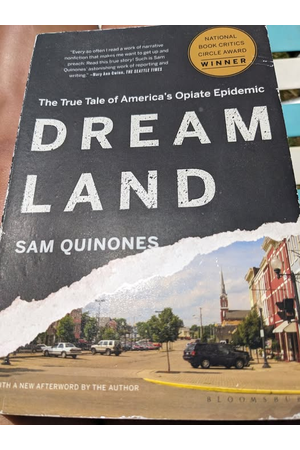
Excellently done journalism. Quinones follows several parallel threads that all contributed to the tragic explosion of prescription painkiller and heroin abuse across America's midsize and smaller cities, from the late 90s to the early 2010s: A decentralized network of many small-time Mexican heroin traffickers who focused on customer service, fungible workforce, ability to fly under the radar, and avoidance of violent encounters; the addicts themselves; the medical establishment that insisted that prescription painkillers were non-addictive; local police and DEA; anti-drug activists. While parts were repetitive, overall it was extensively researched and well done. It almost read like a less made-for-TV follow-on to Narcos. The content is of course deeply sad and infuriating .The book was published eight years ago.
Quinones has a more recent book (The Least of Us) that I now want to read; I heard him interviewed on Econtalk for it a few years ago.
Fiction. I picked it up at the library because I had read another novel by the same author a few years ago and liked it. (Lake Success, though I think his most famous novel is Absurdistan, which I have not read.) It was off to a funny start but got very, very long. I should have quit it. The main character is a twentysomething hipster named Vladimir in NYC who had immigrated with his family from the Soviet Union in the 80s and gets sucked into an absurd plot wherein he masterminds a pyramid scheme for the benefit of Russian mafiosi in a fake post-Soviet Eastern Bloc city called Prava.
I think I read it to the end because only last week did I get to the library to stock up on my next summer reading options.
May 2023
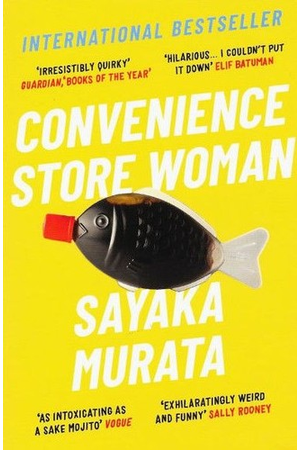
Weird! Nor do I exactly remember why I put it on my hold queue. It's fiction, and very short, so I read the whole thing sitting at the pool today. The main character is someone who never fit into others' expectations of what normal people do or think, and while she's in school, she discovers that the very predictable environment of a convenience store suits her. So that's what she does, for eighteen years, at the same convenience store. And then the plot of the book, which is mercifully short, interrupts that straightforward world. I didn't care much for the plot, but it was a fun read. The main character, from her perch as a daytime-shift convenience store worker, observes the world of normal people and their expectations with a distance, seeing and appreciating her own role as a cog in the things that make the world go round, such as easily accessible cold drinks on hot days. (Which, I think, is an accurate and sometimes very useful perspective, for normal people too.) It reminded me a little bit of those cartoons of aliens who engage in human stuff.
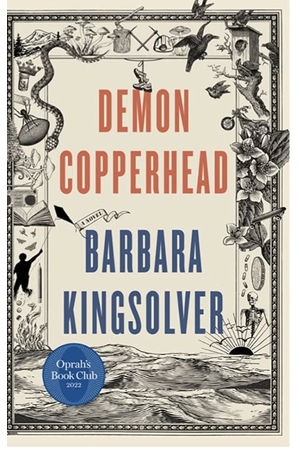
I don't read a lot of fiction, because for the most part I don't like it (I have a really hard time getting into something I know didn't happen), but I read an end-of-year book review for this book in the NYT, the content of which I don't remember at all, but it sounded interesting enough that I got on the very long hold queue for it. My turn finally came up. It was extremely good. Apparently, it is a riff on Dickens's David Copperfield, which I have never read, set in late-90s southwestern Virginia. It's told from the point of view of a child-then-teenager in and out of the foster care system and navigating the utter destruction of his world by prescription painkillers. Parts are reminiscent of Hillbilly Elegy. The language in which it's written is so much fun to read. And the characters are done so three-dimensionally well.
April 2023
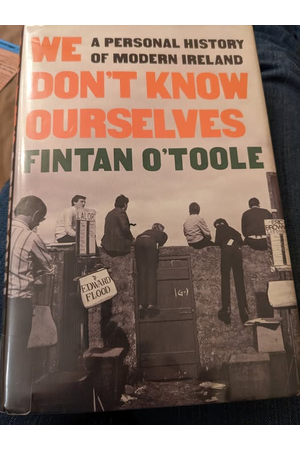
Big, big read. The author tells the last half-century of Ireland's history, not as a textbook but as a series of anecdotes, some of them involving him personally. Because of that, it meandered a lot, which both made the book very long but also meant it included details on culture, religion as actually practiced, and music. The book has a main message which is that (according to O'Toole, at least), up until the Euro crisis, Ireland's political and religious life (which were closely intertwined) relied on deliberate ambiguity and willful ignorance. As a result, there was no acknowledgement of hypocrisy or corruption, so both could run rampant. While I hadn't really known much about Ireland before reading this book (and I'm glad to have learned), I do wonder whether he was trying too hard to fit the facts to that particular story he wanted to tell; he sure disapproves of the church. And of course I wonder if there's another side. I half considered quitting pretty much throughout, due to length, but kept going mainly because the writing, particularly when he went off on a tangent of random details, was magnificent.
Lots of interesting discussion in Facebook comments with Irish friends. One thing I was particularly curious about was names: I’ve observed that some Irish people have Anglo names and some have Irish names, and I was wondering if those names had significance (Jewish names have high significance, and I’m told Hindu names do as well). Here is what one of my friends said: “Well there are names that are originally English language (like mine) and names that were originally Irish (eg O Ceallaigh). Each has translations in the other language (MacStiofan, Kelly for these two examples). At one point a name that was originally English might have an ethnic or class or cultural implication but it’s a pretty weak association at this point (e.g my other three grandparents were O’Neill, Kelly and Carroll). There has certainly been an increase in the use of Irish versions of names, both given names at birth, and adults just switching. Within the country there are people/groups/families who are more or less interested in specifically Irish culture - language/music/sport/literature. Some of that is certainly associated with ethnic background, some with geography, some with politics, some is personal preference. Historically there was a strong association between political and cultural leanings. Still there but weaker than in the past. But I digress …”
February 2023
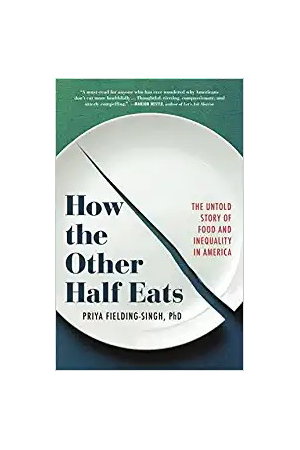
The author, a sociologist, embedded with four families with kids in the Bay Area, at different socioeconomic strata, as well as in-depth interviews with thirty families of various races, cultures, and wealth levels, to study their approach to eating and feeding a family. Of course, in a family, food is part of nearly everything that happens, so that meant a fascinating level of detail on the most mundane aspects of their lives. The author hits you hard with her political beliefs, and I found myself wishing it were not quite so heavy-handed, but her research was so interesting. I've often had the experience myself of being in a grocery store and looking at the carts of the other moms (they're nearly always moms) and thinking about how different those carts' contents are from mine (even when the other moms appear socioeconomically and culturally similar to me), and realizing that that means a lot of different realities on practically every detail of their lives. The parts about the tradeoffs forced on the poorer moms in this book were heartbreaking. Not the point of this book, but my takeaway upon finishing it : It's so easy to forget just how lucky we are to have access to all this food and food technology in our lives. Truly amazing.
January 2023
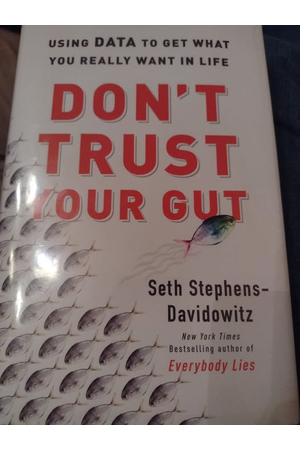
I don't know why I had this book out, but it's out of renewals and a fast read. Since I just finished Advent of Code 2022, I had a weekend day to read. His writing style is fun, though I can't say this book taught me anything I didn't already kind of know. But it's due, and I'll return it tomorrow!
November 2022
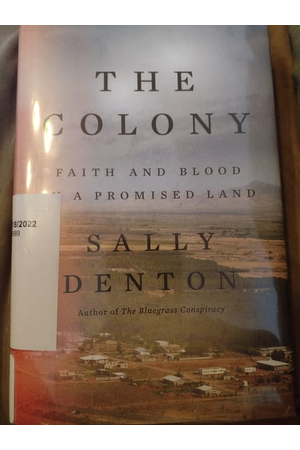
I had read a NYT review of this book and gotten on the hold queue. I had waited a long time for it! Sounded like exactly my kind of thing - nonfiction about a subculture that's far out of the mainstream (a polygamist Mormon breakaway sect in Mexico, and their run-ins with the drug cartels there), written by a journalist whose history of the Bechtel Corporation I had really enjoyed. The book started with a grisly 2019 murder on a Chihuahua backroad of several plural wives and children by cartel enforcers and promised to explain its circumstances. The first half of the book was on the early history of the latter day saints in America, which was quite well written (though, I'm guessing, overemphasizing the bad parts to support some of the later claims in the book). When it got back to modern-day happenings at these breakaway colonies in Mexico, though, I felt like the book got both difficult to follow as well as thin on actual facts and leaning on inferences and suggestion. So it didn't actually explain the story that well, I thought. I even considered quitting the book like 80% of the way through, but it was overdue at the library and I forced my way to the end before returning it.
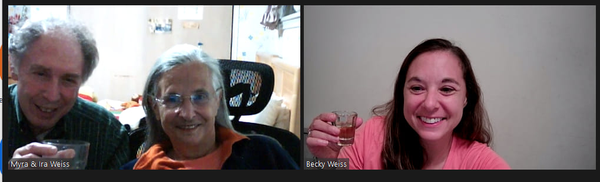
The Five Books of the Torah. At the encouragement of my mom, I am participating in the current round of the 929 project, along with her and my sister who shall not be named on social media. The 929 Project, run by the Israeli ministry of education, has people all around the world reading each of the 929 chapters of the Tanakh (Hebrew Bible), one chapter a day, five days a week, over the course of three and a half years. We started in Feb. Today, we had a little virtual celebration of our completion of the Torah last week. Although my mom and sister have previously read the entire Torah for various reasons (and in fact this is my mom's second round of 929), this was my first time personally reading the Torah in its entirety, an accomplishment of which I'm proud. I learned a lot.
חזק, חזק, ונתחזק! Strong, strong, and let us become stronger!
September 2022
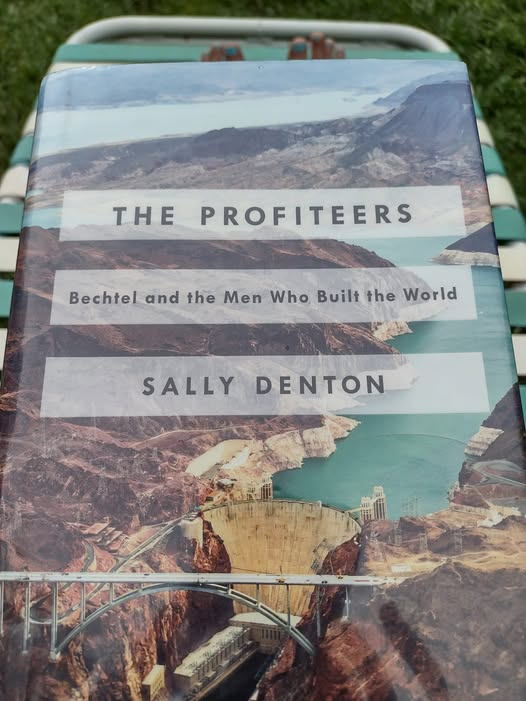
I picked this book up after reading a review of her newer book and discovering that the hold queue for it was two miles long. This book, written in 2016, was available, though, so I read it instead. Excellent. I figured I'd enjoy it because I had enjoyed "Barbarians at the Gates," and I did. Though what this book actually turned out to be was a history of the last few decades of American foreign policy, as told via the story of the company that apparently had a disproportionate influence on it. Most interesting to me was the telling of the major news stories of the 80s and 90s, which (as a kid/teen) I had vaguely understood as being "about oil," but this book makes a case that all those events (Iran-Contra scandal, Gulf Wars, etc) were actually driven by Bechtel's particular business interests. Whether that's as black-and-white a story as Denton makes it out to be, it was interesting. The book having been written six years ago, I did kind of wish that it extended all the way to the present.
I think that wraps up summer reading season 2022!
August 2022
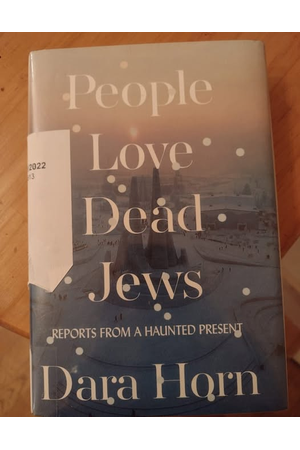
I know the author, a wonderful friend of mine back in college. I've been waiting for her book on the hold queue for quite some time. Dara's other books are fiction (and also great); this one is nonfiction, which, in general, I prefer over fiction. It's a collection of essays on the topic of antisemitism. I love Dara's writing and probably would even if I didn't know her. The special thing about her writing is how deeply she can get into details while keeping it interesting, which she certainly did here. Obviously, the topic of this book is weighty, and for that reason I felt a little funny reading it at the pool. Some things I hadn't known anything about (the story of the Jews of Harbin, China) and others that I had (that nobody's name actually got miswritten at Ellis Island). A hypothesis that surfaced in a few of these essays was the historic and profound uncoolness of Jews - how they represent that freedom is possible only by accepting immense personal responsibility - how that notion has been threatening, inconvenient, and kind of a bummer throughout the ages for people who do not realize how important true freedom is. This idea got me thinking back to a central insight of Morality, Rabbi Lord Jonathan Sacks's final book and easily one of the most memorable books I've read: That the outsourcing of (what should be) personal morality, often to the state, historically has led to societal collapse. Putting these two together might get to a theory that the promise that G-d made to Abraham - "I will bless those who bless you and curse those who curse you" - might have been more of a correlation than a causation. That the acceptance or rejection of this historically uncool minority is a harbinger of acceptance or rejection of the kind of personal responsibility on which a society depends.
(Written later, in 2026: Dara wrote this book before the horrific events of October 7. The surge in Jew-hatred we have seen since does seem to stem from misguided and dis-educated rejections of morality and responsibility. Light does beat darkness in the end, and I believe that will happen, though I do not know how long it will take.)
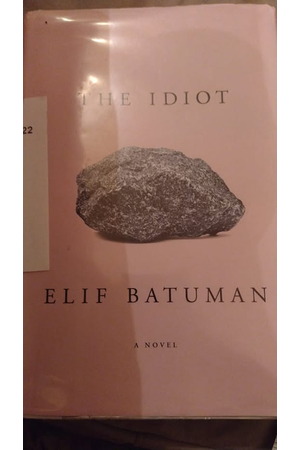
This is fiction, which is unusual for me. But it's only somewhat fiction, I'm not sure to what extent. I kind of knew the author, but not well. She was a friend of a friend in college. (And she refers to things that actually did happen our freshman year, such as the gentleman who was high on shrooms and jumped out of a third floor window naked.) I saw a review of the sequel to this novel, which just came out, and I was curious what she had written about. I had fun reading this book. Batuman is an excellent writer, and she has a remote and absurd kind of sense of humor that I find very funny. The nominal plot was around some kind of unrequited love, the object of which seemed a little lame and unworthy, which I think was deliberate. He's a Hungarian math major, whom the main character follows to Hungary over the summer. Maybe the wtf over why she's even interested in this unresponsive guy is part of the absurdity? The foreignness of her summer in Hungary worked well with the detached sense of humor. I suspect the book has deeper ideas in it that might have been beyond me; there's a lot of discussion around language (Russian, Hungarian, Turkish) and how it is used to frame things.
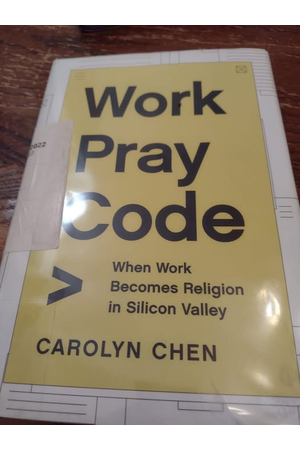
Obviously an intriguing premise, and one that's probably occurred to anybody who works in my industry. (Or at least to me. As my distant relative by way of marriage, Bob Dylan, says, "You're gonna serve somebody.") While the premise of the book has a ton of potential, the writing could be better. Kind of all over the place, though short. There are things she talks about that I'd expect, like how work-religion rushed in to fill a vacuum left by religion-religion in the last three decades. She draws a connection to the fancy SV employers that provide so many perks on site, of which serving their employees' "religious" needs is just one. I don't quite buy that connection. The most interesting chapter was about the marketing of Buddhism to the "productivity" crowd, though the only Buddhists she interviewed were those selling it to corporations (and, predictably, circumspect about denouncing it, as it's how they make their living), and I would have liked to hear the perspectives of Buddhists whose religion is being sold in this way. She concludes with an only slightly on-topic jeremiad against the Bay Area's inequality, I think the connection being hypocrisy. Disappointingly, even though the publication date is 2022, no discussion of the pandemic and its effect on work-religion. (It seems she did her research 2013-17.) I had fun reading it.
July 2022
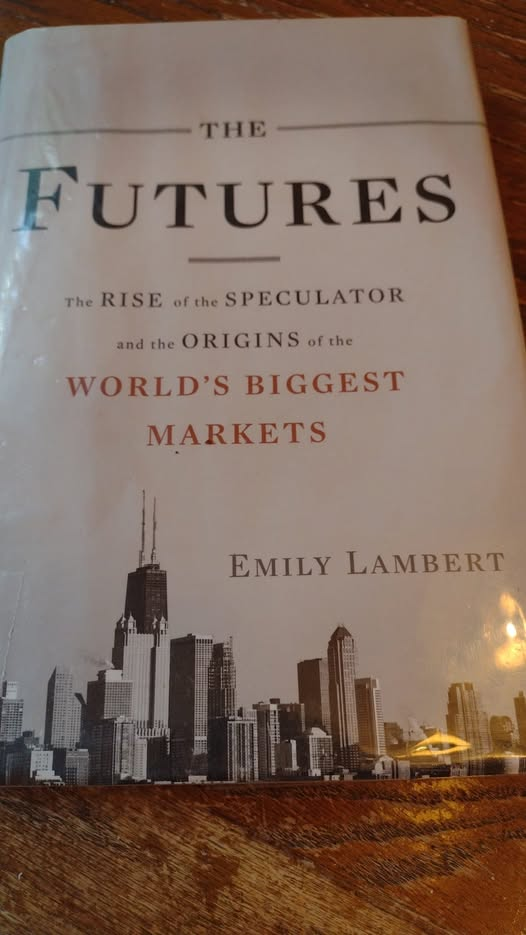
Found this book on the shelf near something else I was looking for. I really, really wanted to like this book, and I'm not yet sure whether I'm quitting it. It's the story of the Chicago Board of Trade and the Mercantile Exchange, the two institutions that invented the concept of agricultural futures. I was also interested from a personal-historical standpoint, since my grandfather, Seymour Weiss, may his memory be for a blessing, made his career in the wheat pit of the Chicago Board of Trade, a nearly unbelievable rags-to-riches story. (And, yes, he enjoyed gambling, a lot. And I learned that "king of the wheat pit" was a real thing!) The Chicago history in this book - of the various neighborhoods and ethnicities involved - is fun. The stories of the idiosyncratic personalities involved - these were all people who were more comfortable than the average bear with risk-taking - also fun to read. But I lost interest as Lambert went into one new futures market after the other, and in none of them did she do a good job explaining the technical details, which I was very curious about but couldn't quite piece together. (For example, a few years ago, Planet Money ran a great story about a wild fiasco with the onions futures market. The story gets a mention in this book, but without the details you'd need to understand it.) Grandpa is not mentioned in the book (which might be just as well!) though I'm pretty sure he knew all these people. Also, interestingly, it was the Merc that was the Jewish institution - the Board of Trade was predominantly Irish, so Grandpa might have been somewhat of an anomaly there.
I might come back to it if I finish my next book before this one comes due. Not sure.
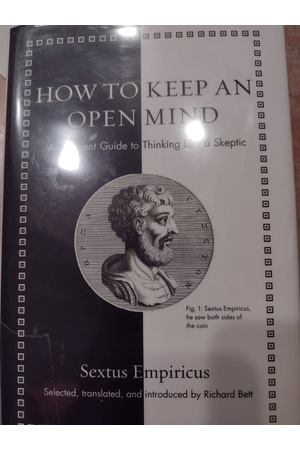
The idea seemed interesting, but I ended up quitting the book. Even though it was very short, the actual translated Greek was too dense for me to get through. But the intro was all right, and here's the premise: The term "skeptic" doesn't mean what we mean when we use that word colloquially. He means, specifically, refraining from drawing conclusions about the truth of any matter. The claim is that this open-minded posture is less stressful, because if you have firm conclusions about the nature of things, you'll get wrapped up in seeking what's good and avoiding what's bad. (So, probably incompatible with faith on some of the more consequential topics) This way of thinking is pretty foreign to me, and I didn't even see how it's possible, so I wanted to learn more. Though, as previously stated, I couldn't get through it! So I've got no clue how to suspend judgment in all things like he says. Color me skeptical (in the colloquial sense!)
June 2022
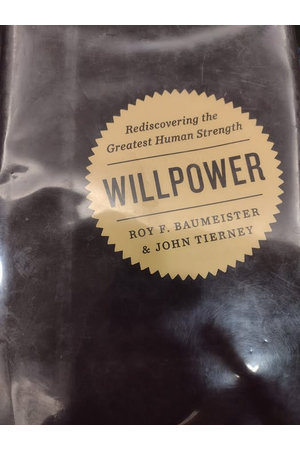
Baumeister was mentioned on a podcast I listened to (Econtalk) for another book he had written, on the topic of evil. FCPL didn't have that, but they had this one. Obviously, the topic of willpower is of interest to anybody trying to improve anything, and this book was therefore interesting in a life-hacky way. Cause and effect can be hard to sort out for a bunch of these studies, which the authors sometimes acknowledge, and I think the studies try to address, but nonetheless those questions hung over the book as I read it. Two things I took away (though there was a lot more here - but these were the most interesting to me): 1/ Seems as though reducing your decision space helps with willpower. (So, habits, actionable Todo lists, religious observance). 2/ The mechanism of PMS, according to this book, isn't "chemicals making your brain sad," but rather a diversion of glucose from the brain to the reproductive system, whereas the brain depends on glucose for all manner of self-control, including regulation of thoughts and emotions. (In my experience, it is all about water retention, actually. There’s something about excess retained water that seems to mess with the brain.)
May 2022
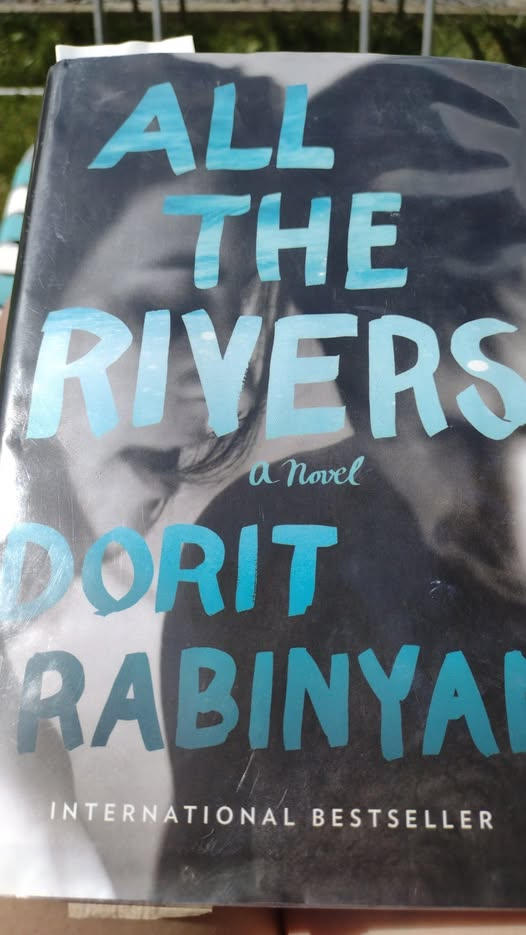
Fiction, which I don't usually enjoy. I didn't enjoy this one either! It's a love story with a tragic ending. I probably would have quit it if I hadn't been traveling so much recently. Part of what I didn't like is something I often don't like in fiction, which is over-description of scenes and people's emotional states. I might have enjoyed trying to read it in the original Hebrew just as a language challenge - it was light enough that I could probably have done it, slowly -and so maybe it was translation making it feel too heavy-handed, I don't know. (Why was I reading fiction? At my nephew's bar mitzvah a few weeks ago, I got the chance to chat with a friend-in-law who reads a lot, and I had asked him for a recommendation... To each his own!)
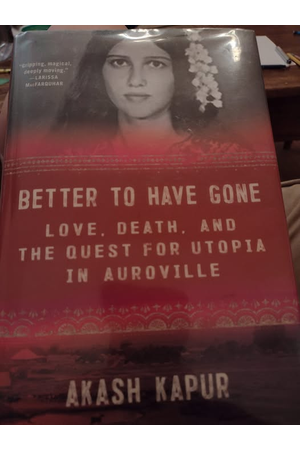
Auroville was, and still is, an environmentalist, communitarian utopian community near Pondicherry, India. The author and his wife both grew up there in its early years, in the 70s-80s. The book traces the lives and, later, tragic deaths of the mother and (unofficial) father of his wife, Auralice, both of whom were traveling Western twentysomethings of means who had ended up there. I've long been interested in attempts at building various kinds of utopia over the years, everything from the Shakers to kibbutzim to even places like Hershey. This one was a bit harder for me to understand since the religious/cultural context in which it operates is one I don't know enough about to have thoughts on how true the society was to the ideals. Though it was especially neat that the story was told by a guy who had one for in and one foot out. He grew up there, but clearly his family was wealthy enough to leave and send him to school in America... And then he and Auralice returned in the 2000s to raise their children. Kapur is very carefully neutral as he tells the story of Auroville, because of which you can't quite tell what he thinks of the spiritual leaders around whom the community was built - whether he reveres them or considers them to be charlatans. Seems it might be a complicated mix of both.
April 2022
Part history of educational theory (fascinating), part lite explanations of neurological mechanisms involved in learning (ditto), part some kind of weird fanboyism of a robot building class at MIT (eh, I think this part didn't work so mostly skipped those sections towards the end). As someone whose day job is probably 70% teaching, an insight that I'm trying to incorporate is the mechanism behind curiosity (since a curious person is ready to learn): You get curious not when there's an open, unmapped space in front of you, but rather when you know most of the territory and there's a missing puzzle piece - we're wired (so he says) to make the missing synapses. I have no background in any of this science, so I'll take his word for it; at least it makes intuitive sense. In the history part, he also talks about a classroom model called "monitorial school," in which less experienced children were taught mostly by more experienced children. Apparently this method was used primarily for poor children in 19th century America, to save money on staff, and therefore became stigmatized and fell out of favor - despite the fact that it had strong evidence showing its effectiveness when compared to a traditional classroom. And thinking about my own education in high school and college: Learning from more advanced or smarter peers as well as the opportunity to sometimes be that peer (in addition to being so fortunate as to have what I think were done of the best teachers there are) - These were pretty significant. A lot of what we learned, we taught each other. I wonder why you don't see that model attempted anywhere more formally.
(My physics teacher from high school, Bob Horton, replied here, saying “Use Study Groups!” As he was about so many things, he is 100% right about that one.)
February 2022
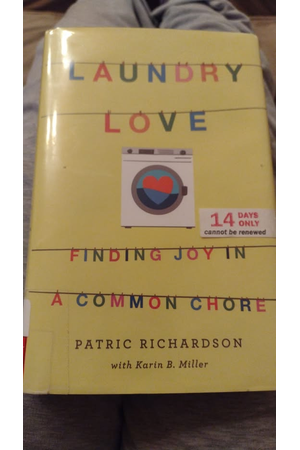
This book is about... Laundry. I was in the library looking for something new to read, and a woman my parents' age stepped up to me and said she thought I should read it. I asked no follow-up questions. So I read it! (14d no renewal too, so I had to bust a move). It's an article stretched out to a book, but fun to read anyways, since the author's style is entertaining. So, my takeaways: He's very anti detergent and basically any laundry product that a normal person might buy at a normal store. (Which raises some questions - If these items were so terrible and there are more effective ways to clean clothes... Why are the regular detergents the only things sold by the normal stores?) He advocates, instead, using "soap flakes." Says that because they're less sudsy, they do what soap is supposed to do, which is lower the surface tension of water so that it can clean more effectively, and says that when you use soap instead of detergent, you can use the fast cycle, warm water, on everything, because not as much rinsing is needed. When I looked up soap flakes on Amazon, it became clear this was a bougie product, not for me. So instead, Ivory was on sale at the store, so I just grated a bar and used that in my last few loads. I can't tell if there's a difference. Today at Walmart I found cheap soap flakes ("Zote"?) and seemed cheaper than regular detergent, and the washes are faster, so game to try. But I do like the extreme scentedness of Gain, so I'm not sure how long I will stick with this. There are some other practical tips too on stain removal, something I've never been good at, as well as stink removal for workout clothes (he says spray with vodka, haven't tried that yet). He's super into line drying. Nope. Also he seems to own fancier textiles than I do and a lot of it is about how you don't actually need dry cleaning. Everything I own is cotton (and wool socks!) so I don't even know where the dry cleaner around here is.
Glad I read it, and I'm game to try cheaper soap and faster loads, but I think I ... wasn't the audience.
(Update in 2026: I currently use Tide Free & Clear, at the recommendation of the NYT Wirecutter. Though in general I do not trust the Wirecutter. But I have been enjoying that there’s kind of a raw, slightly chemical - though subtly appealing - smell to that detergent. When the detergent needs a smell, my current preference is Persil. Wisk was great but is no more.)
January 2022
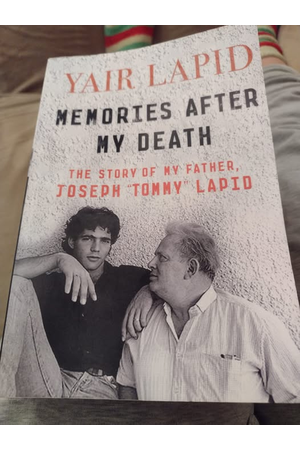
Lapid was, briefly, the Prime Minister of Israel. My mom had sent me this book for Hanukkah and told me I'd enjoy it. She was right. This book is the "autobiography" (not really) of colorful Israeli newsman turned media personality turned politician Tommy Lapid. I don't usually read biographies, but this was a good one both for the excellent and funny writing as well as the historical perspectives. Especially interesting were the parts about Tomislav Lapid, having survived the Holocaust, arriving on the last boat out of Yugoslavia to the brand-new country of Israel as a solo 17-year-old boy, having lost his entire family. As the survivors disembarked from the boat, all of the men and teenage boys were immediately directed to the army. Tommy was put into a unit of Serbian and Croatian speakers, because the army didn’t really know the difference. What an incredible life story - the whole thing was interesting.
The book was published in the 90s, and it describes people so down on their luck that it was hard for me to read. That, and I looked up the topic on the internet, and it seems that the reporting in this book had some trouble being verified. So the heavy subject, together with not knowing if these stories were even fully true, makes it hard for me to keep going with it.
The author's podcast, Hidden Brain, is my fourth favorite. It's interesting, and a short read (read nearly all of it on a single airplane flight), but redundant with Hidden Brain if you listen to it regularly. The idea is that those of us who pride ourselves on being rational and truth-seeking may scoff at delusions, prejudices, and just flat-out wrongness of people we see as less rational or even dumber than us, but these delusions can actually (not always, of course) result in better real, non-delusional outcomes. A little bit timely too, reading this book after the last year and a half. The book points out that delusions are more common when people feel more fear. So, if you're not a Hidden Brain listener, I recommend it.
An interesting read if you work somewhere that keeps asking you if you're innovating (ahem). The key insight is that innovation != invention, and it is the more important of the two in advancement of the human condition. "Innovation" here is defined by the sweaty work of iterating on some big idea to make it usable in a real-world context, something I've found pretty important in my work. Most of the body of the work are various history-of-science stories along various themes (medicine, food production, communication, etc), some definitely more interesting to me than others, but each kind of fun to learn about. For whatever reason, it took me some time to get through, though I enjoyed it.
The author sets out to hike the Appalachian Trail in 1996. He and his hiking companion, Katz, neither of whom is a particularly experienced hiker, have a series of pretty miserable-sounding experiences, which the book relates hilariously. As in his other books, the best part about Bryson's writing is where he goes off on historical digressions, which he does on both the trail itself, the National Park Service (which he holds in low regard), and the small towns he encountered along the way. Pretty fast and fun read. While I never had any interest in extreme hiking, I have even less than that now.
I didn't quit this book and should have. I picked it up since it was on the "librarian recommends" shelf at the library - I usually have good luck with that, since it turns out librarians know something about books. He's a biographer, and this book said it was about how he came to find purpose in his life despite always being a... "fish out of water." That's a phrase I apply to myself, and, probably like everybody, I look for meaning in what I do, so I gave it a try. The book has a few problems, though. First, the writing is a bit ivy-league self-indulgent. Which is great for learning new vocabulary, but grating. I kept reading, though, because the writing was sometimes funny, and I figured he was about to get to the point. Nope. The search-for-meaning part doesn't come into the picture until the last few pages and isn't explained very well. Disappointed to have stuck with this one.
The topic promised to be fascinating - the story of the shipping container. I really wanted to like this book, or more precisely I want to be the kind of person who would have enjoyed this book. It was just too much detail about boats. I was having to force myself through it. Quit after 60 pages. Too bad; think I could have really enjoyed a less deep version, because I'm interested in the topic, if not this particular way of presenting of it.
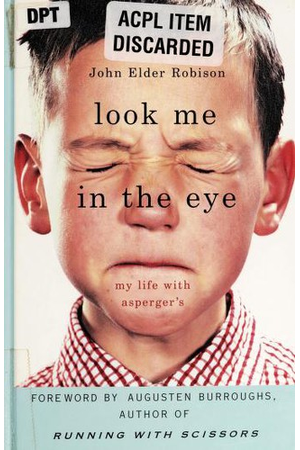
I picked this book up kind of at random off a free books shelf. Highly recommended; I spent most of today reading it start to finish. It's the author's memoir of his childhood and young adulthood with Aspergers. Besides the excellent writing, I liked it for two reasons. First, while I'm fortunate not to have the same degree of challenges he has in interacting with others, I nonetheless relate to them in kind: the trial-and-error process of training yourself in what "normal people" expect from their interactions with you, in particular figuring out when logic is and isn't helpful in those interactions. Or maybe everyone finds those challenges at least somewhat relatable, I don't know. Second, the guy's ability to fix and design mechanical and electrical things lead to a lot of really neat stories, including a stint designing the crazy special effects for KISS's concerts in the 70s, a stint designing early electronic toys for Milton Bradley, as well as some ridiculously elaborate pranks he pulled off as a teenager.
Very cool! The whole book is a series of short factual articles on things you might see in a city - those etchings sprayed in the sidewalk; roundabouts; walk signs; inflatable dancing noodles; empty facades - and the history of how and why they got exactly the way they did. It's often a messy combo of functional needs, design preferences, politics, and foibles. (One could write a very similar book on technology!) Love knowing this stuff. Due to poor planning of library holds and renewals, I had to return the book having read only half of it. It's okay, because it's organized in little standalone articles, so I'll just get myself back in the holds queue.
The thesis of the book is that if you can avoid various forms of self-delusion, and if you can avoid hanging too much on your identity, you'll both get more things right (that part is kind of tautological) as well as be happier and have more of the good impact you want to have. I found this book to be highly thought-provoking.
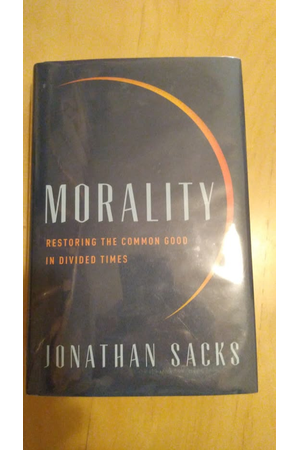
If I could double-underline this, I would. It is among the most influential books I have read in my life. The central idea here is that the anger and malaise we see around us can be attributed to a shift in society from "We" to "I" attitudes, whose root cause is a failed outsourcing of morality to the political state and the markets as each has expanded over the past few decades. It's worth reading both because of its compelling ideas as well as exceptionally good writing. Along the way is a fascinating review of Western philosophy throughout history, as the context for this shift; I hadn't thought much about any of that since high school, and it was interesting to revisit. He expresses some hope at the end that people might have had enough and might seek to return to morality, though his evidence isn't there (I hope he's right). The author, the late Rabbi Lord Jonathan Sacks, was the former Chief Rabbi of the UK and published the book in 2020 right before his death.
So many new and interesting things learned here and definitely changed what I assumed money is. (Among them a deeper understanding of the connection between shadow banking - essentially things people considered money, but weren't - and the '08 financial meltdown. By the way, my recommended reading list on 2008 has "All the Devils Are Here" at the top, followed by "The Big Short.") I'm a big fan of Jacob Goldstein from his work hosting the Planet Money podcast, so as soon as I heard he had written a book a few months ago, I got in the hold queue for it.
Almost couldn't put it down (I read it in a day); a fascinating, thought-provoking, and quite sad history/memoir of several generations of her family in rural Kansas. Her method of telling her story was a little strange, and I can't tell whether I liked it; the book is narrated in the second person, to a baby that she never had, the lack of which created an opportunity for her to get out.
The author worked on the "buy side" (hedge funds) on Wall Street in the first decade of the 2000s. Wolf-of-Wall-Street levels of partying and cocaine, but no FBI. Fun to read just for the descriptions of extreme bacchanalia, but a pretty easy-to-predict arc (it's supposedly a true story, so I can't exactly fault him for it being predictable, I guess). It commits a cardinal sin of narration, at least for me: it's related in the present tense. Seems a pretty sure bet the author will be seeking to sell movie rights, and I kind of hope he gets them.
I read this book to learn a little more about something I had only really understood on the surface and wanted to understand one level more deeply. While I was able to mostly follow because of previous nerdcursions into this space, so I knew how to spell "RDD," I don't think it's a good choice for someone starting from first principles. Not that I know what would be a good source, if you're trying to learn by reading. I had previously built up my knowledge, such as it is, of this topic by taking a Coursera class a few years back and then, more recently, bumbling around in a Spark environment we use at work. Also, they get bogged down in places talking about the details of specific integrations; that might have been better put in a reference of some kind. So, I found it helpful, but probably not for everybody.
The author is a journalist in Michigan who knows a guy from his childhood who joined the Amish. The writing is a little clunky; it's very much in the third person, reporting things that happened when the writer very much wasn't there, and you feel it. The content is fascinating (to me). One thing I didn't realize is the quite the variety of plain-living ways of life in America, of which the guy's friend explores a few. It's short but took me forever to get through.
Highly recommended. There was a real-life hermit in central Maine who had disappeared into the woods in 1986 and remained for 27 years. He would break into cabins and a nearby summer camp and steal food and other things he needed, making absolutely no human contact despite being wanted for about a thousand burglaries over those years. (In 2013, Maine state troopers caught him breaking into the camp.) The details of how the hermit survived Maine winters, and hid out, were interesting, but the author also does a fascinating study of the different kinds of hermits out there as well as the effect of solitude on the brain (the elimination of noise is a solid positive). Apparently this guy was the longest-running known case of a human having zero contact with other humans. The second-longest is the last surviving member of an Amazon tribe in Brazil, for whom the Brazilian government has created a reservation where he continues to have no human contact and traps animals for food.
The authors are WSJ journalists who broke a story a few years back about Jho Low, a Malaysian fraudster who bilked his country out of billions of dollars with mind-bendingly convoluted schemes involving corrupt middle eastern princelings and shell companies... All to fund an equally unbelievable level of decadent partying and consumption. (Part of what he did with the stolen money was to produce The Wolf of Wall Street.) The book is really well written, and the storytelling is good, although the financial transactions are near impossible to follow (by design, I guess!) But it made me sad over the existence of such corruption.
A few months ago, in response to some things that were making me sad at work, a friend brought up the possibility that I was "just Rosencrantz and Guildenstern," i.e. just a side plot off some main plot that I'm not really a part of and that doesn't make any sense. I was intrigued by that idea - and found it somewhat comforting - so I put that play on hold at the library. Then there was a global pandemic. But now that I can pick up my library holds, I read it. Meh. Impossible to follow, particularly because Hamlet was impossible to follow in the first place. But I still think the overall concept of being a side-plot who can't make sense of the main plot is a useful one. That’s why it’s underlined; the meta-idea of being an NPC in someone else’s game can be a very useful technique.
Fiction. Really enjoyed it. The storytelling in this book is indirect and creative; the book follows a town in the Berkshires over the course of eight or so years, switching perspective between characters and often referring to events only indirectly, after they happen. The plot of the book isn't the main thing (and I don't much like plots anyways), but it's mostly around the arrival of a rich investor from New York in town, as he flees NYC after September 11, and deciding to become the town's first selectman and personally fund its operations entirely out of his pocket instead of with taxes. The characters' different, uneasy takes on dependence on government are fascinating.
I picked this up on the new releases shelf a few weeks before the world ended because it looked interesting. Bharara was the US Attorney of the Southern District of New York, and this book is a combo of war stories and reflections on what justice actually means, plus a discussion of some of the challenges inherent in being a prosecutor. Fascinating window into a world that, thank G-d, most of us see only dramatized on TV. And very thought provoking even if you're not a prosecutor. Something about the tone of this book suggests that Bharara intends to run for public office, so you do have to take what he says about himself with a grain of salt. It's quite well-written, and I definitely learned something.
The author sets out to wash dishes in all fifty states. I had picked up this book assuming he was some NPR type who was doing this to make for interesting journalism and, you know, really get to know America, and I was fine with that; I loves me a good This American Life. But it was better than that! The author, by his own admission, was a ne'er-do-well who wanted as little responsibility in life as possible. The whole book is about a series of jobs he works and quits. He lives a life that's simplified to the extreme (a theme I love!) and assiduously avoids being promoted to something other than dishwasher. The middle of the book is awesome, just due to the variety of places he works (a fishery, a summer camp, an oil rig, and many different kinds of eateries in between) and how he ruthlessly optimizes his life for floating around and eating for free. The end of the book is a disappointment, though. He meets a girl, doesn't finish his quest, finally sells out to write a book about it, then takes advantage of his birthright to Irish citizenship to move to Amsterdam because he likes how they ride bikes there. So I guess he kind of becomes an NPR type. And literally appears on NPR.
Strongly recommended. It's the story of the 1989 leveraged buyout of RJR Nabisco. The story starts by taking you through the rise of the respective RJ Reynolds and Nabisco companies, how each started as a business focused on serving its customers; followed by their mergers and the rise of a CEO who seemed to enjoy the trappings of executive life much more than he cared about cigarettes or Oreos. He starts exploring the idea of an LBO because he was bored with a stock price that he felt was low. And then all of Wall Street swooped in for an insane bidding war, with what seemed to me overly complex financial maneuvers. Fascinating, but sad to see so much money sloshing around for no benefit to the customers or business of Nabisco or RJ Reynolds. The writing is top-notch - the authors were WSJ journalists - and the edition I was reading had a "where are they now," written two years ago, twenty years after the events of the book. Apparently there's also a movie, made in 1993. I'm hoping to see it.
This book was written in 1998 about a guy exactly my age, Cedric Jennings, who grew up in Southeast Wash DC and attended Brown University; the book is about his senior year of high school and then his freshman year of college. Suskind is a journalist who wrote the book while its events were happening, and he seems to have obtained a remarkable level access to Cedric Jennings's experience as well as the people around him. Both the story itself and the reporting are remarkable. (I also loved the mid-90s cultural references throughout the book.) I just wish that Suskind could come back with some sort of where-are-they-now epilogue 20-30y later; given Jennings's resilience and drive, I wouldn't be surprised to hear that he's done something interesting since then.
About two years ago, I heard the author interviewed on Econtalk about a book he had just written about the battle between Hulk Hogan and Gawker (https://www.econtalk.org/ryan-holiday-on-conspiracy.../); it had sounded fascinating, so I looked it up in the Fairfax County Public Library catalog, but they didn't have it. However, they did have this book, and enough people I know have been interested in Stoicism that I figured I'd put myself in the hold queue for it, even though the queue was long. Finally came available, and I read it. It's a quick read. I'd put it in the same category as How To Stop Worrying and Start Living (Dale Carnegie) and The Subtle Art of Not Giving a F#@% (Mark Manson), both of which are books I recommend to folks who are trying to handle feelings of despair. They're both books I agree with strongly. Though as much as I know I'd be better off if I were to implement the ideas in them, I still haven't quite figured out the execution. This book is like that. He's right, but ... okay, now what? The other thing I'd say is that, like Manson, at some point you realize that the author is very young, and you wonder what standing he has to tell you how to perceive, how to act, and how to persevere.
Quit after a few pages. Something about the premise of this book feels dated; the crowd doesn't seem so wise. (The book may well have offered a more nuanced and interesting take if I had actually read it, which I did not.)
This book was so good that I started and finished it today. The book is about the author's four (more?) years of navigating homelessness and poverty brought on by an unplanned pregnancy by working as a house cleaner. Really well-written and thought provoking, particularly the parts where she thinks about the lives of the people whose houses she cleans, to many of whom she's entirely invisible.
Highly recommended. My dad knew the author from KlezKanada. Kirshenblatt, born in 1916 in Opatow, Poland and escaped to Toronto as a teenager in 1934, taught himself to paint while in his seventies and painted hundreds of scenes from his extremely vivid memories of that time. He wrote this book to go with those paintings. The narrative is done with no sentimentality or judgment and is stream-of-consciousness; you feel like you're sitting across a table from him. He especially enjoyed observing the various tradespeople in town, Jewish and Polish (there were some very arbitrary distinctions between which trades were for Jews and which were for Poles), and he goes into some fascinatingly deep but mundane detail on things like how a wire brush gets constructed. (It's more complicated than you might think.) It being a town full of Jews, there are of course plenty of funny characters with strange nicknames. The most amazing thing to me from this book, though, is that the world it describes existed only one hundred years ago.
Excellent but highly profane, like don't read this to your kids. I heard about this from my sister who had picked it up at random in Grand Central Terminal to enjoy on her commute, and it turned out there was a chapter on our dad in it. Really well written. Bonus: The author is an Evanston Township High School (and ETHS Choir!) alum. Thus we would have overlapped in choir one year, but she would have been a sophomore and I probably wasn’t paying too much attention to them. The chapter about my dad is profound. He treated Sam’s father despite Mr. Irby’s penchant for alcoholism and other forms of self-destruction. And did it with such chesed (kindness) that Sam discusses him at length in her book, mentioning that he is 1/ an Orthodox Jew and 2/ rides his bicycle everywhere (can confirm both!) I was proud beyond belief. My older sister eventually got a hold of Sam to thank her. The juxtaposition of one of the holiest people I have ever met with this otherwise highly profane memoir was jarring but kind of heightened my awareness of how decency and kindness shine a light through … anything.
Sometimes I pick up books more or less at random from the library, and this was one. It's a book of short stories. I didn't make it past the first. Not for me.
I took the rare 14-day-no-renewal commitment for this one (it was short, so I knew I could do it). Lewis has written a lot of famous books, including one of my all-time favorites (The Big Short). This book was not his best, but he's such an incredible journalist (is that the right word for what he does?) that the individual stories were great. He seems to have written this book as a rebuttal to a "govt is inefficient and wasteful" position, and he lays it on thick with his own politics (which I don't recall from his other books); that got on my nerves at times. But the stories were incredibly well researched and told, and I learned something new about how weather data is handled.
Picked up this book thinking it was something different from what it was. I thought it was going to be a CIA guy talking about his experience working undercover and how he got people to trust him while he does that, which I was curious about. It was kind of about that. But it was more a self-help book (which isn't a problem; I like those too)... and ... boy, is he into himself. Also his classification of personality styles didn't match my experience. Quit a third of the way through.
EJF had picked this up for me as an act of love. I was very excited. It was a little too over the top even for me. I just couldn't. Quit about a quarter way through.
Wow. Really good book. I had been aware of it, since I had read Wild (Cheryl Strayed) a year ago and really enjoyed that, and it was one of those recommendations for people who liked Wild. The author is a journalist reporting on a sad trend among older Americans who deal with their precarious financial situations by going "houseless" and living in a camper. This book was incredibly well-written.
Fiction (which I don't often do). I read a book by him a couple years ago (Thank You For Smoking), and it was hilarious. This book is hilarious too. Like TYFS, it's about a lobbyist hack, though this time the hack's job is to make Americans hate China to drive up defense spending. You have to be willing to put up with a gags-per-sentence rate that's close to 1. I definitely am into that, though I could certainly see someone finding that over the top.
14 day no renewal, which meant averaging more than one rule per day! Last summer, I read Homo Deus, and while I can't quite say I exactly liked it, it was thought-provoking (I have not read Sapiens, which is his most famous book). This book is more or less a rehash of Homo Deus under a different structure, but I didn't quit the book because I find his predictions of the future interesting. He has a few chips on his shoulder that come across loudly, particularly in the middle section on religion and related topics, in which he seemed to favor skewed caricatures. He comes to an unexpected and, to me, somewhat unsatisfactory conclusion at the end for what to do about all of it. I can't decide whether I'm glad I read it or whether I should have quit.
This is a fun, fast read on why the demonization of big business and the narrative of how it ruins everything is probably wrong. It made a lot of points I was expecting (e.g. how the scale of big biz lowers transaction costs) and a few I hadn't thought about (like its function as a carrier of reputation and norms). I kind of got the point after a while and would have quit the book, except the airplane I was on didn't have movies, so I finished it.
The author was the FBI operative who took down Robert Hanssen in 2001, and this book is his story about that. Great read, unbelievable story, especially if you enjoyed the TV show The Americans. The guy was caught on a trail that’s on one of my running routes in Vienna.
Fiction. Really liked it. A middle aged man is on a pointless business trip to Saudi Arabia and has some very random adventures there. Enjoyable level of weirdness.
Best book yet this summer. I had been waiting on hold for it for weeks, and I had been interested because I had heard the anthropologist author interviewed on the Hidden Brain podcast, and I was expecting the book to be an expansion of that (pretty funny) interview. It does start out funny, with the author describing his taxonomy of BS jobs - flunkie, taskmaster, duct taper, box ticker, and goon - and a statistic that 37% of Americans earn their living at a job that they believe does not need to exist. But then the book gets way more interesting. He maps both feudal social structure and theological concepts onto modern corporate organizational practices. He also dives into some obvious questions like how it's possible for a theoretically efficient economy to have so many such jobs, or why BS jobs often are paid so much more highly than jobs everyone agrees add clear value.
The author is a liberal atheist who decides that most portrayals of Evangelical Christians seem to be divisive caricatures, so she joins Falwell's church in Lynchburg for the better part of a year as a way to get a three dimensional understanding of Evangelicals. She gets baptized, makes friends, even goes on a mission with the church. Her portrayal of the people and concepts she encountered were thoughtful, respectful, and fascinating. Strongly recommended.
When my daughter saw me reading this, she asked, “So, Mom, you’re looking to learn about how to be subtle?” She’s right. For the most part, the human failure mode that this book attempts to address is one I’m lucky not to have. And I do see that so many times when someone is upset, it is because they were assigning too much importance to something. (Of course, sometimes people are upset about real things.) But it’s important to remember how common it is - for most anyone - to be overweighting on some thing they thought they really wanted.